Teaching Deep Time with respect, cultural Integrity and empathy in My Place Episode 25: 'Before Time: Bunda' and Episode 26: 'Before Time: Barangaroo.'
Deep Time Teacher Guide: Bunda & Barangaroo
Purpose of this guide
Episodes 'Before Time: Bunda' and 'Before Time: Barangaroo' introduce students to the deep time histories of First Nations Peoples, highlighting enduring connections to Country and the sophisticated systems of kinship, law and knowledge that have been sustained over tens of thousands of years and continue today.
This guide supports teachers to approach these episodes with:
- Truth‑telling
- Cultural safety
- Historical accuracy
- Respect for First Nations sovereignty
- Deep listening to Country and community
- Age‑appropriate clarity for primary students
These episodes are not ‘prehistory.’ They are living histories, carried through story, ceremony, kinship and Country.
Context overview: Deep time and cultural continuity
Episodes 'Before Time: Bunda' and 'Before Time: Barangaroo' support students to explore the enduring histories, cultures and knowledge systems of First Nations Peoples. Through these stories, students are introduced to the sophisticated systems of knowledge, law, kinship and connection to Country that have been nurtured over tens of thousands of years and continue to shape communities and cultures today.
This overview supports teachers to engage with these episodes respectfully and with cultural integrity, guided by the FIRST Framework and the Australian Curriculum Version 9.0 Deep Time History sub-strand. Deep Time History recognises the long and continuous histories of Aboriginal and Torres Strait Islander Peoples and emphasises the importance of understanding these histories as living, ongoing and connected to the present.
Teachers are encouraged to familiarise themselves with the following resources before continuing with this guide:
FIRST Framework (Australian Curriculum)
https://www.australiancurriculum.edu.au/resources/first-framework
Deep Time History of Australia Resource (Australian Curriculum)
https://www.australiancurriculum.edu.au/support-resources/learning-area-resources/deep_time_history_of_australia_resource
Where appropriate, teachers are also encouraged to connect learning to local Aboriginal histories, communities and Country. Engaging with local perspectives and cultural authority can help students understand the diversity of First Nations experiences and knowledge systems across Australia, while fostering meaningful connections to the Place in which they live and learn.
Understanding Country and time
Aboriginal and Torres Strait Islander Peoples have diverse understandings of time, Place and connection. Deep time histories can include creation stories, knowledge traditions, ancestral beings and the formation of Coun, waterways and skies. These histories and knowledges support understandings of identity, responsibility, relationships and caring for Country.
Kinship systems help organise relationships, responsibilities and decision-making within communities. Seasonal calendars also reflect detailed knowledge of local environments, although these vary between Countries and communities and are shaped by local ecological conditions and cultural practices.
It is important to recognise that First Nations Peoples are not a single cultural group. Knowledge systems, beliefs, practices and understandings of Country differ across Nations and communities. Where appropriate, teachers are encouraged to connect learning to local Aboriginal and Torres Strait Islander histories, perspectives and cultural authority.
Key ideas for students
- First Nations Peoples have diverse ways of understanding time, place and connection.
- Country is deeply connected to culture, identity, knowledge and responsibility.
- Creation stories and knowledges help explain relationships, responsibilities and connections to Country.
- Kinship systems play an important role in organising relationships and responsibilities within communities.
- Knowledge about seasons, weather and the environment is specific to different Countries and communities.
Life on Country
Life on Country is grounded in relationships and responsibilities to Country, family and community. Across different First Nations communities, knowledge may be learned and shared through observation, listening, participation, storytelling and guidance from Elders and other knowledge holders. The ways knowledge is shared, and who has responsibility for sharing it, are guided by cultural protocols and community practices that vary across Nations and communities.
Knowledge of local environments informs how people gather and prepare food, care for water sources, manage fire, build shelter and move through Country. These practices reflect deep understandings of place and are responsive to local environments, seasons and changing conditions.
Key ideas for students
- Knowledge can be learned and shared in many ways, including through observation, listening, participation and storytelling.
- Kinship systems help shape relationships, responsibilities and decision-making within communities.
- Ecological knowledge supports caring for Country and guides everyday practices.
- Knowledge and practices are responsive to Country, seasons and place.
- Cultural protocols and ways of sharing knowledge vary across First Nations communities.
Knowledge systems and technologies
First Nations knowledge systems are place-based and intergenerational. They include fire practices, water management, food systems, navigation, astronomy and material technologies.
These practices show deep scientific knowledge of ecology, engineering and sustainability. Technologies are carefully designed for local environments and purposes.
Key ideas for students
- Knowledge systems are scientific, ecological and relational
- Technologies are adapted to place and purpose
- Songlines and astronomy guide movement and knowledge
- Fire and water management support long-term care of Country
Cultural continuity and change
First Nations cultures are the oldest continuing cultures in the world. Knowledge is sustained through story, ceremony, art, song, dance and connection to Country.
Communities have adapted to major environmental changes over time while maintaining cultural identity, law and responsibility. Continuity reflects strength and resilience.
Key ideas for students
- Culture continues through story and practice
- Knowledge is passed across generations
- Communities adapt while maintaining identity
- Continuity reflects resilience and sovereignty
Respecting First Nations voices (FIRST Framework)
Teaching deep time history requires respectful engagement with First Nations communities and knowledge holders.
Teachers should:
- Find out what local stories and knowledge can be shared
- Include First Nations voices through endorsed resources
- Respect partnerships by seeking permission and guidance
- Support student learning with culturally safe practices
- Take time to build relationships and deepen understanding
This approach ensures that teaching is culturally safe, accurate and grounded in community authority.
- Aboriginal Astronomy (National Museum of Australia)
https://www.nma.gov.au/explore/features/indigenous-astronomy -
Aboriginal Memories of Coastal Drowning (Nunn and Reid, 2016)
https://doi.org/10.1080/00049182.2015.1077539 -
Brewarrina Fish Traps – Baiame’s Ngunnhu
https://www.nma.gov.au/explore/features/aboriginal-fish-traps -
Budj Bim Cultural Landscape (UNESCO)
https://whc.unesco.org/en/list/1577 -
Country and Place (AIATSIS)
https://aiatsis.gov.au/explore/country-and-place -
Deep Time History of Australia (ACARA, 2023)
https://www.australiancurriculum.edu.au/support-resources/learning-area-resources/deep_time_history_of_australia_resource -
Firesticks Alliance – Cultural Burning
https://firesticks.org.au/ -
FIRST Framework (ACARA)
https://www.australiancurriculum.edu.au/resources/first-framework -
First Australians (National Museum of Australia)
https://www.nma.gov.au/explore/features/first-australians -
Indigenous Seasonal Calendars (CSIRO)
https://www.csiro.au/en/research/indigenous-science/Indigenous-seasonal-calendars -
Lake Mungo research (National Museum of Australia)
https://www.nma.gov.au/explore/features/lake-mungo -
Narragunnawali resources (Reconciliation Australia)
https://www.narragunnawali.org.au/resources/teachers -
Our Cultures Continue theme (ACARA)
https://www.australiancurriculum.edu.au/resources/aboriginal-and-torres-strait-islander-histories-and-cultures/our-cultures-continue/ -
Songlines on Screen (ABC Education)
https://www.abc.net.au/education/songlines-on-screen/ -
Tagai constellation resources (Torres Strait Regional Authority)
https://www.tsra.gov.au/the-torres-strait/culture/tagai -
This Place series (ABC Education)
https://www.abc.net.au/education/this-place/ -
Truth-telling in the Classroom (Australians Together)
https://australianstogether.org.au/resources/teaching-resources/truth-telling/ -
We Are Here theme (ACARA)
https://www.australiancurriculum.edu.au/resources/aboriginal-and-torres-strait-islander-histories-and-cultures/we-are-here/ -
We Survive Change theme (ACARA)
https://www.australiancurriculum.edu.au/resources/aboriginal-and-torres-strait-islander-histories-and-cultures/we-survive-change/
Deep time histories through First Nations perspectives
Deep time helps students understand that the history of Australia extends far beyond colonisation, encompassing more than 65,000 years of continuous connection to Country, culture, knowledge and custodianship. Deep time recognises the long and enduring presence of Aboriginal and Torres Strait Islander Peoples and the sophisticated systems of knowledge, law, kinship and cultural practice that have been maintained across countless generations.
Across Australia, First Nations Peoples hold diverse understandings of Creation, Country, time and history. These understandings are embedded in stories, knowledge systems, cultural practices and responsibilities that are specific to particular Nations, communities and Country. Learning about these perspectives can help students appreciate the depth, diversity and richness of First Nations histories.
Importantly, deep time should not be understood as belonging only to the distant past. First Nations cultures, knowledges and connections to Country remain living, dynamic and continuing today. Deep time connects past, present and future, demonstrating the ongoing strength, resilience and cultural continuity of Aboriginal and Torres Strait Islander Peoples.
Through this learning, students can develop a broader understanding of Australia's history and recognise the significance of First Nations perspectives in shaping how we understand Country, culture and community today.
Principles for ethical, culturally safe teaching
Truth-telling with care and clarity
Teaching deep time requires language that is accurate, respectful and grounded in First Nations perspectives. This means recognising sovereignty and using phrasing that reflects the depth and continuity of culture, such as acknowledging that First Nations Peoples have lived on this continent for tens of thousands of years and that knowledge is passed down through story, ceremony, kinship and Country. It also means making clear that stories are held and cared for by the communities to whom they belong. Terms such as ‘prehistoric’, ‘primitive tools’, ‘myths and legends’ and ‘nomadic’ should be avoided as they diminish cultural complexity and authority.
Country as teacher
Students need to understand Country as a living presence rather than a backdrop. Country is alive, relational and storied, and it holds law, identity and belonging. Teaching should invite students to notice and respond to the world around them, including wind, sound, movement, animals, seasons, sky and water. In this way, learning is grounded in attentiveness and respect for Country as a source of knowledge.
Kinship and responsibility
Deep time stories show that children learn through observation, participation, storytelling and responsibility to family and Country. Knowledge is not given freely at any time, it is shared by the right people in the right way and at the right time. This reinforces that learning is connected to relationships and accountability, rather than individual acquisition.
Cultural continuity, not a frozen past
Deep time should not be presented as something that has ended. Teaching should emphasise continuity, adaptation and resilience, showing that First Nations cultures remain strong and active. Cultural practices continue and knowledge systems remain living and relevant, connecting past, present and future.
Multiple perspectives and ways of knowing
When engaging with Before Time narratives, students can explore the diverse ways First Nations Peoples understand and relate to Country. This includes recognising that knowledge is held, shared and passed on through a range of cultural practices, and that stories can communicate important understandings about identity, belonging, responsibility and connection. Learning in this context encourages students to engage respectfully with different perspectives and ways of knowing, while appreciating the diversity of First Nations cultures across Australia.
Respecting Cultural Authority (FIRST Framework)
Ethical teaching is grounded in respect for cultural authority and community protocols. Teachers should draw on endorsed resources and established local partnerships, and follow appropriate protocols when engaging with Aboriginal and Torres Strait Islander histories, cultures and knowledges. It is important to recognise that decisions about what knowledge can be shared, and by whom, are determined by communities and cultural authorities. This approach also supports cultural safety for students and fosters meaningful, respectful connections to local Country, histories and perspectives.
Preparing students to engage with 1788 episodes 25 & 26
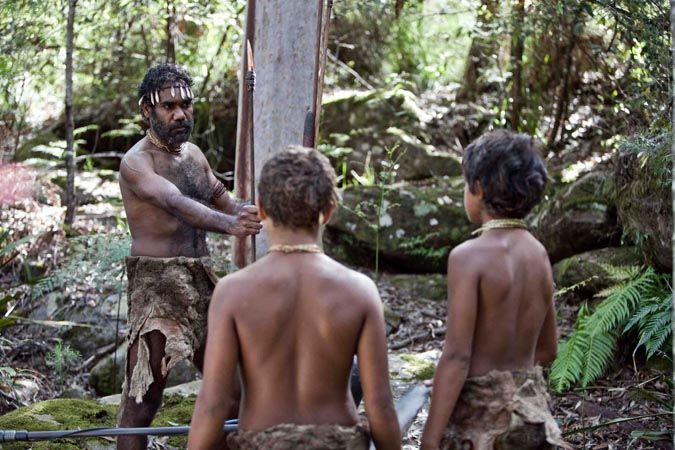
Before viewing, explain that these stories take place long before 1788, in a time when First Nations cultures were thriving, adapting and caring for Country. Emphasise that these are living cultures, not distant or disconnected from the present. Prepare students to notice relationships, responsibilities, ecological knowledge, and how children learn from Country.
During viewing, encourage students to observe how Bunda and Barangaroo interact with Country and how knowledge is shared. Prompt attention to tools, movement, sound and story as guides for daily life, and support noticing how kinship shapes decisions and how Country communicates.
After viewing, use inquiry questions to deepen thinking and reflection. Ask what Country teaches Bunda or Barangaroo, how they learn from family, community and story, and what knowledge helps them live well with Country. Explore how these stories show continuity across thousands of generations, and invite students to consider what can be learned from these knowledge systems today.
Australian Curriculum Version 9.0
This curriculum matrix brings together learning across Years 4–6, aligning Episodes 25 and 26 with the Australian Curriculum Version 9.0 and creating age appropriate entry points into the Deep Time History sub-strand. It supports teachers to connect learning areas with key content descriptors and capabilities while helping students build an understanding of First Nations histories as continuous, sophisticated systems of knowledge shaped by Country, kinship, ecological expertise, cultural protocols and responsibility over tens of thousands of years.
Episodes 25 and 26 align with the intent of the Australian Curriculum Version 9.0 Deep Time History sub-strand (Year 7) by introducing key concepts to Years 4 to 6 through age appropriate entry points. These include learning about Country, kinship, ecological knowledge, cultural protocols, leadership and responsibility. Students are supported to understand First Nations histories as continuous and sophisticated systems of knowledge developed over tens of thousands of years.
The episodes create strong links to the Australian Curriculum Version 9.0 Cross-Curriculum Priority: Aboriginal and Torres Strait Islander Histories and Cultures. Learning is grounded in Country or Place, Culture, People and Knowledge Systems, positioning First Nations perspectives as central rather than supplementary. Students engage with living knowledge systems that continue to shape identity, belonging and responsibility today.
Connections extend across learning areas within the Australian Curriculum Version 9.0. In Science, students explore First Nations ecological knowledge, seasonal indicators and sustainable practices. In The Arts, they engage with storytelling, movement and visual representation. In Technologies, they investigate tools, materials and systems informed by deep time knowledge. Across all areas, students build capability in the Australian Curriculum Version 9.0 General Capability: Intercultural Understanding through engagement with cultural protocols and perspectives, and develop the Australian Curriculum Version 9.0 General Capability: Ethical Understanding as they reflect on responsibility, cooperation, fairness and care for Country and community.
| Year level | Key focus areas | How the episodes support learning |
|---|---|---|
| Year 4 | Diversity of First Nations Peoples, social organisation, connection to Country, sustainable resource use | Kinship roles in Bunda and Barangaroo’s world highlight responsibility, belonging and cultural protocols. Ecological knowledge is shown through water gathering, fishing and yabbies, reinforcing continuous connection to Country. |
| Year 5 | Causes and effects of change, perspectives, significance of cultural practices | Leadership and decision making are explored through Barangaroo’s role. Students engage with learning from Elders and recognise continuity of cultural practices across generations. |
| Year 6 | Interactions between people and environments, custodianship, continuity | Seasonal knowledge and reading Country demonstrate sustainable practices and deep time continuity. The episodes highlight responsibility to care for others and for place. |
| Year level | Key focus areas | How the episodes support learning |
|---|---|---|
| Years 4–5 | Character motivation, cultural and historical context, interpreting multimodal texts | Students interpret Bunda and Barangaroo’s actions through gesture, silence and movement. Retelling from First Nations perspectives supports understanding of viewpoint and context. |
| Years 5–6 | Analysing relationships and ideas, creating multimodal texts, ethical storytelling | Students create digital stories that reflect kinship, cooperation and leadership. Reflection tasks support respectful representation of First Nations knowledge and values. |
| Year level | Key focus areas | How the episodes support learning |
|---|---|---|
| Year 4 | Living things depend on environments, sustainable practices | Fishing, water collection and harvesting yabbies demonstrate relationships within ecosystems and sustainable use of resources. |
| Year 5 | Adaptations, survival strategies, environmental interactions | Bunda and Barangaroo apply knowledge of animals, water and seasonal change to find food and stay safe, showing observation and adaptation. |
| Year 6 | Science from different cultures, First Nations ecological knowledge | Knowledge of fire, water, seasons and animal behaviour is shown as cumulative, observational and passed through generations. |
| Arts area | Key focus areas | How the episodes support learning |
|---|---|---|
| Drama | Role play, improvisation, character relationships | The dance off and interactions between characters support exploration of kinship, cooperation and conflict through performance. |
| Dance | Movement to communicate ideas and stories | Ceremonial movement communicates meaning, decision making and leadership, emphasising cultural expression. |
| Visual Arts | Symbolism, representation, cultural meaning | Students represent tools, water carriers, yabbies and maps of Country to explore visual storytelling grounded in place. |
| Media Arts | Multimodal storytelling, point of view | Students create digital stories from Bunda or Barangaroo’s perspective, highlighting viewpoint and narrative choice. |
| Year level | Key focus areas | How the episodes support learning |
|---|---|---|
| Years 4–5 | Properties of materials, designing for purpose | Students explore water carrying methods, fishing tools and shelters, recognising everyday technologies developed over deep time. |
| Years 5–6 | Systems thinking, evaluating solutions | Comparing approaches to problem solving supports understanding of tools, systems and sustainable practices in context. |
| Capability | Key focus areas | How the episodes support learning |
|---|---|---|
| Intercultural Understanding | Cultural perspectives, protocols, respectful communication | Students engage respectfully with First Nations perspectives, learning cultural protocols and interpreting communication through movement, gesture and silence. |
| Ethical Understanding | Fairness, responsibility, care, decision making | The episodes highlight cooperation, responsibility and fairness. Students consider leadership, care for others and decision making that respects Country. |
Additional resources for deep time
- Aboriginal Astronomy (National Museum of Australia)
https://www.nma.gov.au/explore/features/indigenous-astronomy -
Aboriginal Memories of Coastal Drowning (Nunn and Reid, 2016)
https://doi.org/10.1080/00049182.2015.1077539 -
Brewarrina Fish Traps – Baiame’s Ngunnhu
https://www.nma.gov.au/explore/features/aboriginal-fish-traps -
Budj Bim Cultural Landscape (UNESCO)
https://whc.unesco.org/en/list/1577 -
Country and Place (AIATSIS)
https://aiatsis.gov.au/explore/country-and-place -
Deep Time History of Australia (ACARA, 2023)
https://www.australiancurriculum.edu.au/support-resources/learning-area-resources/deep_time_history_of_australia_resource -
Firesticks Alliance – Cultural Burning
https://firesticks.org.au/ -
FIRST Framework (ACARA)
https://www.australiancurriculum.edu.au/resources/first-framework -
First Australians (National Museum of Australia)
https://www.nma.gov.au/explore/features/first-australians -
Indigenous Seasonal Calendars (CSIRO)
https://www.csiro.au/en/research/indigenous-science/Indigenous-seasonal-calendars -
Lake Mungo research (National Museum of Australia)
https://www.nma.gov.au/explore/features/lake-mungo -
Narragunnawali resources (Reconciliation Australia)
https://www.narragunnawali.org.au/resources/teachers -
Our Cultures Continue theme (ACARA)
https://www.australiancurriculum.edu.au/resources/aboriginal-and-torres-strait-islander-histories-and-cultures/our-cultures-continue/ -
Songlines on Screen (ABC Education)
https://www.abc.net.au/education/songlines-on-screen/ -
Tagai constellation resources (Torres Strait Regional Authority)
https://www.tsra.gov.au/the-torres-strait/culture/tagai -
This Place series (ABC Education)
https://www.abc.net.au/education/this-place/ -
Truth-telling in the Classroom (Australians Together)
https://australianstogether.org.au/resources/teaching-resources/truth-telling/ -
We Are Here theme (ACARA)
https://www.australiancurriculum.edu.au/resources/aboriginal-and-torres-strait-islander-histories-and-cultures/we-are-here/ -
We Survive Change theme (ACARA)
https://www.australiancurriculum.edu.au/resources/aboriginal-and-torres-strait-islander-histories-and-cultures/we-survive-change/
Teacher reflection: Examining practice and perspective
Teaching about deep time invites ongoing reflection on the perspectives we bring into the classroom. Consider how your own understanding of time, shaped by schooling and cultural context, may differ from First Nations perspectives where deep time is living, continuous and inseparable from Country. Reflect on how this difference might influence what you emphasise, question or leave unexplored, and how you can broaden your approach to include ways of knowing that recognise deep time as present and active.
Think carefully about the resources you draw on and whether they are culturally endorsed, created with or approved by First Nations peoples, and grounded in local knowledge where possible. How are First Nations perspectives positioned in your teaching of deep time? Are they central to the learning, or included as an addition? Consider how you can avoid presenting deep time as distant or ‘ancient’ history, and instead highlight its ongoing significance in shaping identity, culture and relationships with Country.
It is also important to reflect on how you centre Country as a teacher in your practice. How can you support students to learn from place, to recognise the knowledge held in land, story and community, and to understand their own relationship to Country? Finally, consider the opportunities for students to connect deep-time knowledge to contemporary issues such as sustainability and identity, supporting them to respond with respect, care and informed awareness in their own lives.