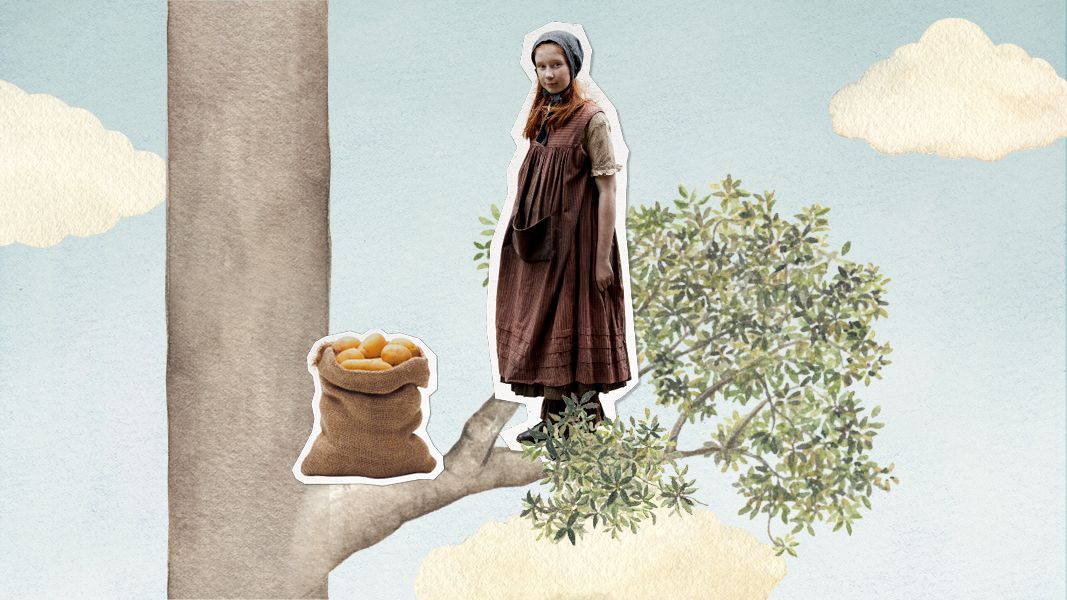
1848: Johanna
Johanna lives with her grandmother, Sarah. Johanna doesn't go to school. She has a job - every day she pushes a barrowload of potatoes around the town, delivering them to her grandmother's customers.
1840s Decade Overview
The 1840s were a decade of invader expansion, settlement consolidation, and growing social change across Australia.
1840s: Pastoralism and small towns expanded, with increased contact between invaders and First Nations communities.
1843: Early moves took place toward representative government in some colonies.
1846–48: Markets adjusted to invader growth, resulting in economic fluctuations and localised unrest.
1848: Migration from Britain continued; families sought new opportunities but faced hardship and adaptation.
First Nations Focus: Students can explore how invader settlement affected Country, food systems, and movement. Discuss how First Nations people maintained cultural practices, cared for Country, and responded to new neighbours and changing landscapes.
Provocation Question
What helps someone feel like they belong, and who decides who belongs?
Clip 1: Torment
Johanna performs chores around town, overhears gossip about her father, and is teased and attacked by local boys because of her bright red hair.
Tuning In
Being different can attract attention and sometimes cruelty. As you watch, notice:
- How Johanna responds to teasing and exclusion
- What the boys say and why they target her
- How gossip affects people’s reputations and feelings
As a class, discuss:
- Why do people tease or exclude others?
- How does gossip spread and who benefits?
- What would make Johanna feel safer or more supported?
Finding Out & Sorting Out
Work together to investigate the effects of gossip and bullying. In small groups, brainstorm:
- Examples of gossip and how it starts
- Short‑term and long‑term effects on individuals and communities
- Who has power in these situations and why
Create a Gossip and Impact (Cause and Consequence) T-chart showing:
- The source of the gossip in the clip
- How it spreads through the town
- Consequences for Johanna and others
Share group charts and suggest one practical classroom strategy to reduce gossip and support someone who is targeted.
Making Connections
Think about a time you saw or experienced unkind talk. Write a short journal entry:
- What happened and how did it make people feel?
- What could someone have done differently?
- What advice would you give Johanna about responding to gossip?
Clip 2: Loves me, loves me not
Johanna reads a letter from her uncle to her grandmother. She plays a practical joke on one of the Owen boys by putting a frog in his chamber-pot. Johanna and her grandmother visit the grave of her mother. Johanna asks about who her father was.
Tuning In
Curiosity and longing shape Johanna’s actions.
As you watch, notice:
- How the letter and the grave visit affect Johanna’s emotions
- Why she plays the prank and what it reveals about her needs
- The questions she asks about family and identity
As a class, discuss:
- How do letters and places (like graves) help people remember and connect?
- Why might Johanna act out when she feels uncertain?
- How do we balance curiosity with respect for others?
Finding Out & Sorting Out
Explore how people use objects and places to hold memory and identity. In small groups, brainstorm:
- Items or places that help families remember absent members (letters, photos, graves)
- Reasons people play pranks or seek attention when they feel vulnerable
- Respectful ways to ask difficult questions about family history
Create a Memory and Identity Card for Johanna that includes:
- One object or place from the clip (the letter or the grave)
- What it reveals about her family story
- Questions Johanna still needs answered
Share cards and discuss how communities can support children seeking family information.
Making Connections
Write a short reflection or poem:
- What object or place helps you remember someone important?
- How does it make you feel?
- What would you say to Johanna about asking questions of adults in her life?
Clip 3: My Father's House
Johanna asks a number of locals about her father but is concerned by the inconsistencies in the information she receives. When she confronts her grandmother about her father, she is given just one enigmatic fact. Johanna's aunt dresses her down for her pranks.
Tuning In
Searching for truth can be difficult and unsettling. As you watch, notice:
- How Johanna pursues answers and how adults respond
- Moments of tension between honesty and protection
- What the “enigmatic fact” suggests about family secrets
As a class, discuss:
- Why might adults hide or soften truths for children?
- When is it important to tell the whole truth, and when might people protect others?
- How do secrets shape family relationships?
Finding Out & Sorting Out
Investigate how communities handle sensitive information and the ethics of truth‑telling. In small groups, brainstorm:
- Reasons adults might withhold information about family history
- The effects of secrets on trust and belonging
- Strategies for asking sensitive questions respectfully
Create a Truth and Trust Chart that shows:
- The questions Johanna asks and who she asks them of
- The responses she receives and their likely motivations
- Possible next steps Johanna could take to learn more safely
Share charts and role‑play one respectful conversation Johanna could have with an adult to seek more information.
Making Connections
Write a short response:
- Have you ever discovered something surprising about your family?
- How did you find out and how did it change your view of that person?
- What would you advise Johanna to do next to build trust and find answers?
Australian Curriculum Links
|
|
Year 3 |
Year 4 |
Year 5 |
Year 6 |
Understanding – Civics and Citizenship |
why people participate within communities and how students can actively participate and contribute to communities |
diversity of cultural, religious and/or social groups to which they and others in the community belong, and their importance to identity |
how citizens (members of communities) with shared beliefs and values work together to achieve a civic goal |
|
Skills – Questioning and Researching |
develop questions to guide investigations about people, events, places and issues locate, collect and record information and data from a range of sources, including annotated timelines and maps |
develop questions to guide investigations about people, events, places and issues locate, collect and record information and data from a range of sources, including annotated timelines and maps |
develop questions to investigate people, events, developments, places and systems locate, collect and organise information and data from primary and secondary sources in a range of formats |
develop questions to investigate people, events, developments, places and systems locate, collect and organise information and data from primary and secondary sources in a range of formats |
Skills - Interpreting, analysing and evaluating |
analyse information and data, and identify perspectives |
analyse information and data, and identify perspectives |
|
|
Skills - Concluding and decision-making |
draw conclusions based on analysis of information propose actions or responses to an issue or challenge that consider possible effects of actions |
draw conclusions based on analysis of information propose actions or responses to an issue or challenge that consider possible effects of actions |
develop evidence-based conclusions propose actions or responses to issues or challenges and use criteria to assess the possible effects |
develop evidence-based conclusions propose actions or responses to issues or challenges and use criteria to assess the possible effects |
Skills - Communicating |
present descriptions and explanations, using ideas from sources and relevant subject-specific terms |
present descriptions and explanations, using ideas from sources and relevant subject-specific terms |
present descriptions and explanations, drawing ideas, findings and viewpoints from sources, and using relevant terms and conventions |
present descriptions and explanations, drawing ideas, findings and viewpoints from sources, and using relevant terms and conventions |
|
|
Year 3 |
Year 4 |
Year 5 |
Year 6 |
Language |
|
|
understand how to move beyond making bare assertions by taking account of differing ideas or opinions and authoritative sources
|
|
Literacy |
use interaction skills to contribute to conversations and discussions to share information and ideas
plan, create, edit and publish imaginative, informative and persuasive written and multimodal texts, using visual features, appropriate form and layout, with ideas grouped in simple paragraphs, mostly correct tense, topic-specific vocabulary and correct spelling of most high-frequency and phonetically regular words
plan, create, rehearse and deliver short oral and/or multimodal presentations to inform, express opinions or tell stories, using a clear structure, details to elaborate ideas, topic-specific and precise vocabulary, visual features, and appropriate tone, pace, pitch and volume
|
listen for key points and information to carry out tasks and contribute to discussions, acknowledging another opinion, linking a response to the topic, and sharing and extending ideas and information plan, create, edit and publish written and multimodal imaginative, informative and persuasive texts, using visual features, relevant linked ideas, complex sentences, appropriate tense, synonyms and antonyms, correct spelling of multisyllabic words and simple punctuation
plan, create, rehearse and deliver structured oral and/or multimodal presentations to report on a topic, tell a story, recount events or present an argument using subjective and objective language, complex sentences, visual features, tone, pace, pitch and volume
|
use appropriate interaction skills including paraphrasing and questioning to clarify meaning, make connections to own experience, and present and justify an opinion or idea
plan, create, edit and publish written and multimodal texts whose purposes may be imaginative, informative and persuasive, developing ideas using visual features, text structure appropriate to the topic and purpose, text connectives, expanded noun groups, specialist and technical vocabulary, and punctuation including dialogue punctuation
plan, create, rehearse and deliver spoken and multimodal presentations that include relevant, elaborated ideas, sequencing ideas and using complex sentences, specialist and technical vocabulary, pitch, tone, pace, volume, and visual and digital features
|
use interaction skills and awareness of formality when paraphrasing, questioning, clarifying and interrogating ideas, developing and supporting arguments, and sharing and evaluating information, experiences and opinions
plan, create, edit and publish written and multimodal texts whose purposes may be imaginative, informative and persuasive, using paragraphs, a variety of complex sentences, expanded verb groups, tense, topic-specific and vivid vocabulary, punctuation, spelling and visual features
plan, create, rehearse and deliver spoken and multimodal presentations that include information, arguments and details that develop a theme or idea, organising ideas using precise topic-specific and technical vocabulary, pitch, tone, pace, volume, and visual and digital features
|
Critical and Creative Thinking
Students analyse the causes and effects of gossip, exclusion and family secrets, and evaluate different perspectives as Johanna searches for answers about her identity and belonging.
Ethical Understanding
Students consider ethical questions about honesty, fairness, gossip, bullying and truth-telling, and reflect on the responsibilities people have when sharing information about others.
Personal and Social Capability
Students develop empathy, self-awareness and relationship skills by exploring experiences of exclusion, identity, trust and belonging, and by reflecting on ways to support others in their communities.