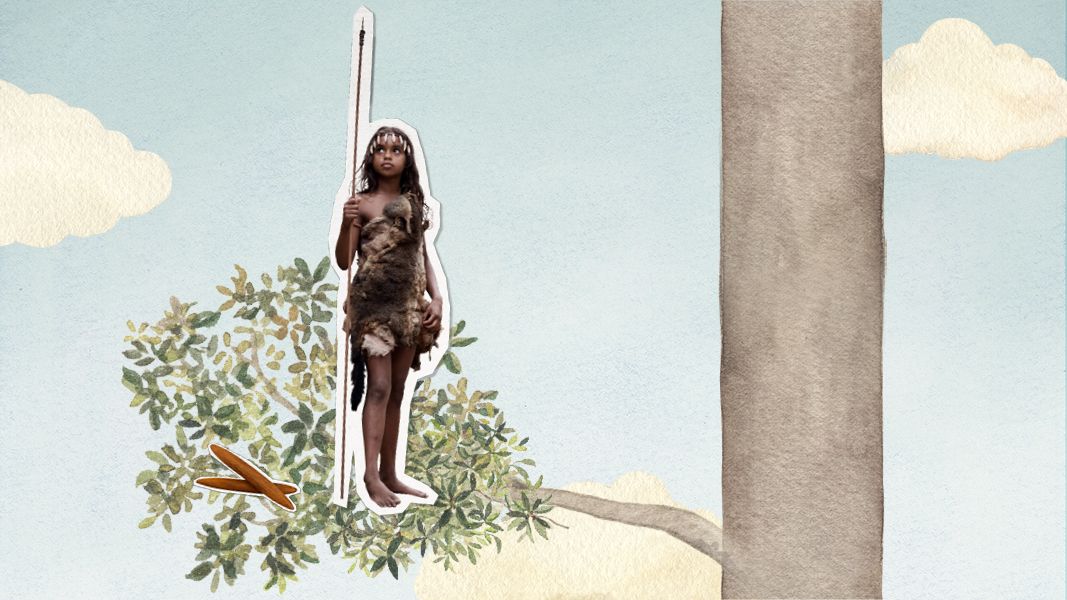
Before Time: Barangaroo
Barangaroo's world would be perfect if only Mani, the biggest boy in her group of friends, would stop trying to be number one. Deep down, Barangaroo knows she's better than he is. That's why Mani keeps shutting her out from important adventures - to make himself look good.
The script for this episode, ‘Before Time: Barangaroo’, was written by Tony Briggs in 2010. Tony Briggs is a a Yorta Yorta / Wurundjeri man.
The stories and characters in this series are fictional, though some storylines are inspired by moments from history.
For the episodes 'Before Time: Bunda' and 'Before Time: Barangaroo', further context and support to the exploration of deep time can be found in the Deep Time Teacher Guide: Bunda & Barangaroo.
Deep Time Overview
This episode of My Place shifts to deep time histories of First Nations Peoples; stories grounded in tens of thousands of years of connection to Country, kinship, law and knowledge systems. The fictional story of Bunda invites students to understand the past not as a timeline beginning in 1788, but as a vast, continuous story shaped by the world’s oldest living cultures.
Deep time history requires respectful partnerships with local First Nations knowledge custodians. Where appropriate, work through established local community relationships to seek guidance from those with cultural authority about what knowledge can be shared. This approach ensures that teaching is culturally safe, accurate and grounded in community authority.
Deep time is not “long ago.” It is now, because Country continues to teach, guide and hold story.
Provocation Question
What does Barangaroo’s story show about leadership, courage and caring for others, and what can we learn from the responsibilities young people carried in her community?
Clip 1: Dance-off
Barangaroo and her friends are warned not to go near Mumuga country, and they discuss the nature of the Mumuga. To cheer up Mung, they decide to host a cook-up. Barangaroo and Mani have a dance-off to see who is the most worthy to carry the spear.
Tuning In
Barangaroo wants to carry the spear, but Mani keeps trying to be the leader. As you watch, think about:
- What does the spear appear to represent?
- Why do you think dance used to decide who carries it?
- What does this moment tell us about leadership and respect?
Finding Out & Sorting Out
In small groups, discuss how roles and responsibilities are shared in this episode of My Place. Then investigate how roles and responsibilities are shared within your local First Nations community and compare any similarities or differences. If appropriate and available, invite a local First Nations community member to share perspectives on caring for Country, community responsibilities and local cultural practices. Include the following points in your questions and research:
- Ceremonial roles
- Gendered responsibilities
- Leadership
- Cultural protocols for carrying tools or objects
Organise your research notes into a Source Analysis Grid:
|
What does the source show? |
Who holds responsibility? |
|
How is leadership shown? |
What values are being taught? |
Apply your thinking and interpret the dance-off using your research by writing or recording a short response to the question:
What does the spear appear to represent in this story, and why is it important who carries it?
Create a mind map to plan your writing, connecting: spear > meaning > responsibility > cultural value
Making Connections
Barangaroo and Mani both want to carry the spear, but their reasons and their responsibilities are different. Think about a time when you had to show what you could do, not by being the loudest, but by showing respect, skill or patience.
Individual or Partner Task:
Create a short multimodal digital story showing how Barangaroo is represented during the dance-off. Use evidence from the story to show her actions, the role of the spear and how leadership and responsibility are represented.
Start with a storyboard to organise your ideas. Remember to include:
- A clear beginning, middle and end
- Cause/effect (challenge > dance-off > understanding)
- At least one respectful action
Clip 2: Yabbies
Barangaroo and Mung collect yabbies for the cook-off. When Barangaroo returns to the camp she finds that Mung has gone missing in Mumuga country, so she and her friends go searching for him.
Tuning In
Barangaroo shows care and courage when Mung goes missing. As you watch, think about:
- What does this moment show about her leadership?
- How do the children respond to danger?
As a class, use the thinking routine: "What Makes You Say That?" Share your ideas and justify them with evidence from the clip.
Use a visual prompt with speech bubbles:
‘I think this shows… because I saw…'
Finding Out & Sorting Out
Consider what this scene reveals about the relationship between people, place and community. If appropriate and available, invite a local First Nations community member to share perspectives on caring for Country, community responsibilities and local cultural practices.
Use a Country, Community and Responsibility Chart to record your observations:
|
Place
|
People
|
|
Responsibility
|
Care
|
Consider:
- How does the episode show connections between people and Country?
- What responsibilities do characters have to one another?
- How does knowledge of place help keep people safe?
- What examples of care, respect or leadership can you identify?
Apply your research to interpret the clip and to answer the question:
What does this story teach us about caring for Country, community and one another?
In small groups, discuss the sequence of events in the episode:
- Mung enters Mumuga.
- Mung goes missing.
- Barangaroo leads the search.
For each event, identify a value that is demonstrated, such as responsibility, leadership, care, courage or community. Use evidence from the episode to explain your thinking and share your ideas with the class.
Making Connections
Barangaroo shows courage and care when Mung goes missing. Think about a time when you helped someone because it was the right thing to do, even if it felt challenging.
With a partner, create a 4–6 panel comic strip or digital storyboard showing the search for Mung.
Include:
- How Barangaroo uses knowledge of Country
- How Barangaroo leads her friends
- How Barangaroo shows responsibility and care
Australian Curriculum Links
|
|
Year 3 |
Year 4 |
Year 5 |
Year 6 |
Knowledge and Understanding - History |
the diversity of First Nations Australians, their social organisation and their continuous connection to Country/Place |
|||
Knowledge and Understanding – Geography |
the ways First Nations Australians in different parts of Australia are interconnected with Country/Place |
|||
Understanding – Civics and Citizenship |
why people participate within communities and how students can actively participate and contribute to communities |
|||
Skills – Questioning and Researching |
develop questions to guide investigations about people, events, places and issues locate, collect and record information and data from a range of sources, including annotated timelines and maps |
develop questions to guide investigations about people, events, places and issues locate, collect and record information and data from a range of sources, including annotated timelines and maps |
||
Skills - Interpreting, analysing and evaluating |
analyse information and data, and identify perspectives |
analyse information and data, and identify perspectives |
||
Skills - Concluding and decision-making |
draw conclusions based on analysis of informationactions |
draw conclusions based on analysis of information |
||
Skills - Communicating |
present descriptions and explanations, using ideas from sources and relevant subject-specific terms |
present descriptions and explanations, using ideas from sources and relevant subject-specific terms |
present descriptions and explanations, drawing ideas, findings and viewpoints from sources, and using relevant terms and conventions |
present descriptions and explanations, drawing ideas, findings and viewpoints from sources, and using relevant terms and conventions |
|
|
Year 3 |
Year 4 |
Year 5 |
Year 6 |
Language |
|
understand how to move beyond making bare assertions by taking account of differing ideas or opinions and authoritative sources |
|
|
Literature |
discuss characters, events and settings in different contexts in literature by First Nations Australian, and wide-ranging Australian and world authors and illustrators
|
|
identify aspects of literary texts that represent details or information about historical, social and cultural contexts in literature by First Nations Australian, and wide-ranging Australian and world authors |
|
Literacy |
recognise how texts can be created for similar purposes but different audiences use interaction skills to contribute to conversations and discussions to share information and ideas plan, create, edit and publish imaginative, informative and persuasive written and multimodal texts, using visual features, appropriate form and layout, with ideas grouped in simple paragraphs, mostly correct tense, topic-specific vocabulary and correct spelling of most high-frequency and phonetically regular words plan, create, rehearse and deliver short oral and/or multimodal presentations to inform, express opinions or tell stories, using a clear structure, details to elaborate ideas, topic-specific and precise vocabulary, visual features, and appropriate tone, pace, pitch and volume |
compare texts from different times with similar purposes and audiences to identify similarities and differences in their depictions of events listen for key points and information to carry out tasks and contribute to discussions, acknowledging another opinion, linking a response to the topic, and sharing and extending ideas and information plan, create, edit and publish written and multimodal imaginative, informative and persuasive texts, using visual features, relevant linked ideas, complex sentences, appropriate tense, synonyms and antonyms, correct spelling of multisyllabic words and simple punctuation
plan, create, rehearse and deliver structured oral and/or multimodal presentations to report on a topic, tell a story, recount events or present an argument using subjective and objective language, complex sentences, visual features, tone, pace, pitch and volume
|
describe the ways in which a text reflects the time and place in which it was created use appropriate interaction skills including paraphrasing and questioning to clarify meaning, make connections to own experience, and present and justify an opinion or idea plan, create, edit and publish written and multimodal texts whose purposes may be imaginative, informative and persuasive, developing ideas using visual features, text structure appropriate to the topic and purpose, text connectives, expanded noun groups, specialist and technical vocabulary, and punctuation including dialogue punctuation plan, create, rehearse and deliver spoken and multimodal presentations that include relevant, elaborated ideas, sequencing ideas and using complex sentences, specialist and technical vocabulary, pitch, tone, pace, volume, and visual and digital features |
examine texts including media texts that represent ideas and events, and identify how they reflect the context in which they were created use interaction skills and awareness of formality when paraphrasing, questioning, clarifying and interrogating ideas, developing and supporting arguments, and sharing and evaluating information, experiences and opinions plan, create, edit and publish written and multimodal texts whose purposes may be imaginative, informative and persuasive, using paragraphs, a variety of complex sentences, expanded verb groups, tense, topic-specific and vivid vocabulary, punctuation, spelling and visual features plan, create, rehearse and deliver spoken and multimodal presentations that include information, arguments and details that develop a theme or idea, organising ideas using precise topic-specific and technical vocabulary, pitch, tone, pace, volume, and visual and digital features |
Aboriginal and Torres Strait Islander Histories and Cultures
Country/Place
Students explore deep connections to Country through Barangaroo's understanding of boundaries, places, resources and responsibilities, including knowledge of yabbies, water and movement through Country. The lesson highlights how caring for Country and respecting cultural protocols guide decision-making and behaviour.
Culture
Students examine First Nations cultural practices through ceremonial decision-making, shared responsibilities and the use of dance, symbols and protocols to teach leadership and respect. The lesson demonstrates how cultural values are passed on through participation, observation and community relationships.
People
Students investigate how identity and responsibility are shaped by kinship, community and relationships with Country through Barangaroo's leadership and care for others. The lesson highlights the important roles young people play in contributing to the wellbeing of their community.
Critical and Creative Thinking
Students investigate leadership, responsibility and decision-making by analysing Barangaroo's actions and applying their understanding of First Nations knowledge, protocols and values to interpret events in the story.
Ethical Understanding
Students explore ethical concepts such as respect, care, responsibility and cooperation as they consider how Barangaroo and Mani respond to challenges and fulfil their obligations to others.
Intercultural Understanding
Students develop intercultural understanding by engaging with First Nations perspectives on leadership, kinship, Country and community, and recognising the strength and continuity of these cultural practices.
Personal and Social Capability
Students build personal and social capability by reflecting on teamwork, leadership, empathy and conflict resolution, and by considering how individuals contribute positively to their community.