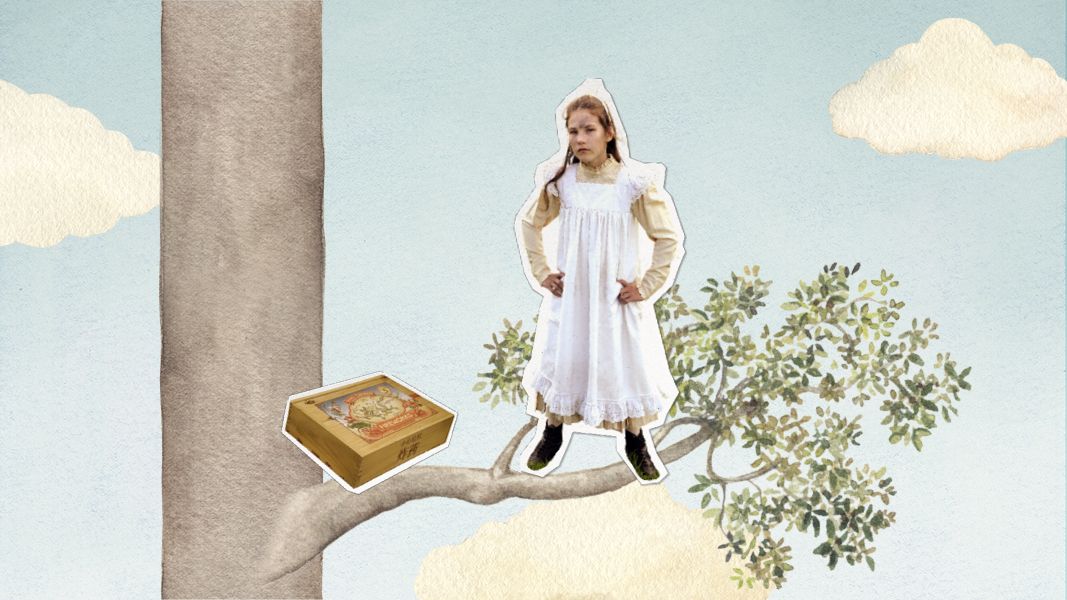
1908: Evelyn
Evelyn can't wait for cracker night. This year, for the first time, her father can afford to buy the family their own box of fireworks. Unfortunately, Evelyn shows the box to her disbelieving neighbour Freddie.
1900s Decade Overview
The 1900s were a time of big changes in Australia, with Federation in 1901 uniting the colonies and new laws giving women the right to vote. While social reforms like pensions and fair wages began, First Nations Australians were excluded.
1901: Federation: Australia became a nation and Edmund Barton became the first Prime Minister; the Australian flag was chosen.
1901: The Immigration Restriction Act (White Australia Policy) passed, shaping identity and migration.
1902: Women gained the right to vote and stand for federal parliament (white women only).
1903: Fanny Cochrane Smith recorded Palawa songs, preserving cultural heritage.
1904: The Commonwealth Court of Conciliation and Arbitration was established to settle workplace disputes.
1906: “New Protection” legislation linked tariffs to fair wages and conditions.
1907: Harvester Judgement set a “fair and reasonable wage” for supporting a family.
1908: The Invalid and Old Age Pensions Act was introduced; Canberra was chosen as the nation's capital; the official Coat of Arms was granted; Dorothea Mackellar published My Country; the Great White Fleet visited Australia.
1909: Boy Scouts and Girl Guides were introduced, shaping youth movements and civic identity.
First Nations Focus: The First Nations focus for the 1900s is about exclusion from nationhood, denial of rights, and the strength of cultural traditions. While Federation was celebrated as unity, First Nations Australians were left out of the Constitution and denied most civic rights, including pensions and fair wages. Despite this, families kept community strong, oral stories and cultural practices alive.
Provocation Question
What does it mean for Australia to become a nation, and how did this shape people’s lives in 1908?
Clip 1: Games from India
Evelyn, her brother Edward and their friend Freddie Müller are playing an imaginary game under the tree. They are pretending to be tiger hunters in India. Miss Müller tells them about tigers and their inability to reverse down trees. Evelyn's father brings home the Mr Wong's 'No. 5' assortment of fireworks to be used on cracker night.
Tuning In
As a class, discuss the following questions:
-
How did books and the British Empire influence the games children played?
-
What sources can help us answer these questions? Think: old books, newspapers, photos, posters, speeches like Parkes’ Tenterfield Address.
-
What does Federation mean for Evelyn’s family and community?
Finding Out & Sorting Out
-
In pairs, make a list of games you play today and compare them with the imaginative games in the clip. What has changed and what has stayed the same?
Making Connections
Evelyn’s story shows how imagination, family life and national identity were shaped by Federation. As a class, discuss the following questions:
- How do stories and games influence the way children see the world?
- What does belonging mean for Evelyn and her family during this time of change?
Write a short reflection: “If I created an imaginary game today, what would it be and what would it say about my world?”
Clip 2: Chores and punishment
Clip 2: Chores and punishment
Evelyn's brother Edward taunts her with the prospect that their father will punish her for being irresponsible about the fireworks. Evelyn needs to complete her chores by five o'clock.
Tuning In
As a class, discuss the following questions:
- Why were chores like polishing silver and waxing tables important for girls in the early 1900s?
- What does Evelyn's brother mean when he shows her the belt?
- Why was corporal punishment common in homes and schools back then?
- How do these scenes show family expectations and discipline?
Finding Out & Sorting Out
In small groups, reserach what corporal punishment was and why it was common in homes and schools in the early 1900s. Then research what the rules are today about punishment at school and at home. Write a short paragraph comparing the past and present and explain which approach you think is fairer and why.
Making Connections
Make a list of the chores Evelyn does in the clip, like polishing silver or waxing tables. Then write down the chores you do at home and compare them. Which chores seem harder, and which would you prefer to do? Explain why.
Australian Curriculum Links
|
|
Year 3 |
Year 4 |
Year 5 |
Year 6 |
Knowledge and Understanding - History |
causes and effects of changes to the local community, and how people who may be from diverse backgrounds have contributed to these changes |
|
|
significant individuals, events and ideas that led to Australia’s Federation, the Constitution and democratic system of government changes in Australia's political system and to Australian citizenship after Federation and throughout the 20th century that impacted First Nations Australians, migrants, women and children the motivation of people migrating to Australia since Federation and throughout the 20th century, their stories and effects on Australian society, including migrants from the Asia region |
Understanding – Civics and Citizenship |
who makes rules, why rules are important in the school and/or the local community, and the consequences of rules not being followed why people participate within communities and how students can actively participate and contribute to communities |
the differences between “rules” and “laws”, why laws are important and how they affect the lives of people diversity of cultural, religious and/or social groups to which they and others in the community belong, and their importance to identity |
how citizens (members of communities) with shared beliefs and values work together to achieve a civic goal |
|
Skills – Questioning and Researching |
develop questions to guide investigations about people, events, places and issues locate, collect and record information and data from a range of sources, including annotated timelines and maps |
develop questions to guide investigations about people, events, places and issues locate, collect and record information and data from a range of sources, including annotated timelines and maps |
develop questions to investigate people, events, developments, places and systems locate, collect and organise information and data from primary and secondary sources in a range of formats |
develop questions to investigate people, events, developments, places and systems locate, collect and organise information and data from primary and secondary sources in a range of formats |
Skills - Interpreting, analysing and evaluating |
interpret information and data displayed in different formats analyse information and data, and identify perspectives |
interpret information and data displayed in different formats analyse information and data, and identify perspectives |
evaluate information and data in a range of formats to identify and describe patterns and trends, or to infer relationships evaluate primary and secondary sources to determine origin, purpose and perspectives |
evaluate information and data in a range of formats to identify and describe patterns and trends, or to infer relationships evaluate primary and secondary sources to determine origin, purpose and perspectives |
Skills - Concluding and decision-making |
draw conclusions based on analysis of information propose actions or responses to an issue or challenge that consider possible effects of actions |
draw conclusions based on analysis of information propose actions or responses to an issue or challenge that consider possible effects of actions |
develop evidence-based conclusions propose actions or responses to issues or challenges and use criteria to assess the possible effects |
develop evidence-based conclusions propose actions or responses to issues or challenges and use criteria to assess the possible effects |
Skills - Communicating |
present descriptions and explanations, using ideas from sources and relevant subject-specific terms |
present descriptions and explanations, using ideas from sources and relevant subject-specific terms |
present descriptions and explanations, drawing ideas, findings and viewpoints from sources, and using relevant terms and conventions |
present descriptions and explanations, drawing ideas, findings and viewpoints from sources, and using relevant terms and conventions |
|
|
Year 3 |
Year 4 |
Year 5 |
Year 6 |
Language |
|
identify the subjective language of opinion and feeling, and the objective language of factual reporting
|
understand how to move beyond making bare assertions by taking account of differing ideas or opinions and authoritative sources
|
understand the uses of objective and subjective language, and identify bias
|
Literacy |
use interaction skills to contribute to conversations and discussions to share information and ideas
identify the audience and purpose of imaginative, informative and persuasive texts through their use of language features and/or images
plan, create, edit and publish imaginative, informative and persuasive written and multimodal texts, using visual features, appropriate form and layout, with ideas grouped in simple paragraphs, mostly correct tense, topic-specific vocabulary and correct spelling of most high-frequency and phonetically regular words
plan, create, rehearse and deliver short oral and/or multimodal presentations to inform, express opinions or tell stories, using a clear structure, details to elaborate ideas, topic-specific and precise vocabulary, visual features, and appropriate tone, pace, pitch and volume
|
listen for key points and information to carry out tasks and contribute to discussions, acknowledging another opinion, linking a response to the topic, and sharing and extending ideas and information plan, create, edit and publish written and multimodal imaginative, informative and persuasive texts, using visual features, relevant linked ideas, complex sentences, appropriate tense, synonyms and antonyms, correct spelling of multisyllabic words and simple punctuation
plan, create, rehearse and deliver structured oral and/or multimodal presentations to report on a topic, tell a story, recount events or present an argument using subjective and objective language, complex sentences, visual features, tone, pace, pitch and volume
|
describe the ways in which a text reflects the time and place in which it was created
use appropriate interaction skills including paraphrasing and questioning to clarify meaning, make connections to own experience, and present and justify an opinion or idea
plan, create, edit and publish written and multimodal texts whose purposes may be imaginative, informative and persuasive, developing ideas using visual features, text structure appropriate to the topic and purpose, text connectives, expanded noun groups, specialist and technical vocabulary, and punctuation including dialogue punctuation
plan, create, rehearse and deliver spoken and multimodal presentations that include relevant, elaborated ideas, sequencing ideas and using complex sentences, specialist and technical vocabulary, pitch, tone, pace, volume, and visual and digital features
|
examine texts including media texts that represent ideas and events, and identify how they reflect the context in which they were created
use interaction skills and awareness of formality when paraphrasing, questioning, clarifying and interrogating ideas, developing and supporting arguments, and sharing and evaluating information, experiences and opinions
plan, create, edit and publish written and multimodal texts whose purposes may be imaginative, informative and persuasive, using paragraphs, a variety of complex sentences, expanded verb groups, tense, topic-specific and vivid vocabulary, punctuation, spelling and visual features
plan, create, rehearse and deliver spoken and multimodal presentations that include information, arguments and details that develop a theme or idea, organising ideas using precise topic-specific and technical vocabulary, pitch, tone, pace, volume, and visual and digital features
|
Critical and Creative Thinking
Students develop critical and creative thinking by investigating how Federation shaped everyday life, analysing historical sources and comparing childhood experiences in 1908 with their own lives today.
Ethical Understanding
Students develop ethical understanding by examining historical attitudes towards corporal punishment and considering questions of fairness, rights, responsibility and changing social values over time.
Intercultural Understanding
Students develop intercultural understanding by exploring how the British Empire influenced children's ideas and games, and by considering the experiences of diverse community members such as the Müller family and Mr Wong within Federation-era Australia.
Personal and Social Capability
Students develop personal and social capability by reflecting on family responsibilities, discussing relationships and expectations within families and communities, and comparing their own experiences with those of children living in 1908.
Additional Resources
Additional Clip: Mr Wong's Emporium
In this clip, Evelyn, Edward and Freddie try to replace the fireworks. They visit Mr Wong's emporium to buy a replacement box but find they can't afford it. They then try to obtain some gunpowder in an attempt to make their own fireworks.
Additional Clip: Cracker Night
Evelyn's family joins the other families in their community to celebrate cracker night with fireworks purchased from Mr Wong's Emporium.