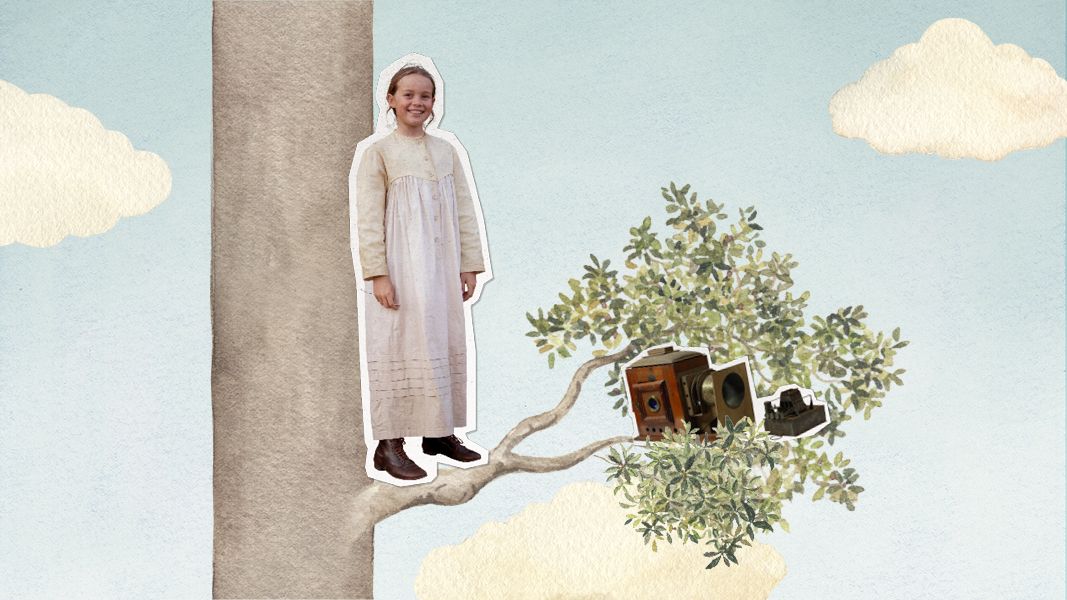
1868: Minna
Minna is bold, curious and full of mischief. When a prank goes too far, she must face the consequences of her actions and learn what it means to take responsibility, repair harm, and rebuild trust.
1860s Decade Overview
The 1860s were a decade of gold, migration and rapid social change. New arrivals from Europe, China and other parts of the world reshaped towns and cities, while children often balanced school, chores and work.
1861: Gold discoveries continued to attract migrants.
1863: The first steam railways expanded transport and trade.
1867: The first Australian-made magic lantern slides were produced.
1868: The last convict ship arrived in Australia, marking the end of transportation.
First Nations Focus: Students can explore how colonisation continued to disrupt Country, cultural practices and family life for Aboriginal and Torres Strait Islander Peoples. Despite these pressures, First Nations communities maintained strong cultural identities, knowledge systems and connections to place.
Provocation Question
What does it mean to make things right when you’ve done something wrong?
Clip 1: The Legend of Bloody Mary
Minna and her friends play the game “Bloody Mary” and scare each other with spooky stories. After Minna breaks a mirror, she decides to frighten the neighbourhood boys by crawling under their house and making strange noises.
Tuning In
Stories can be exciting, mysterious, and sometimes a little frightening. As you watch, notice:
- How Minna and her friends use imagination
- Why people enjoy telling spooky stories
- What happens when a joke goes too far
As a class, discuss:
- What makes a story fun, and what makes it unkind
- Why people sometimes enjoy being scared
- How we know when someone has crossed a line
Finding Out & Sorting Out
Work together to explore how stories create suspense and emotion. In small groups, brainstorm:
- What elements make a spooky story (setting, sound, surprise)
- Why people tell scary stories
- How stories can influence behaviour
Create a Story Ingredients Map using images, words, and symbols to show:
- The elements used in Minna’s story
- The elements used in stories you know
- What these reveal about imagination and fear
Share your map with the class and explain your choices.
Making Connections
Minna’s prank goes further than she intended. Think about a time when you misjudged a situation.
Write a short journal entry responding to the following questions:
- When does a prank stop being fun?
- How do you know when someone is uncomfortable?
- What advice would you give Minna about using stories responsibly?
Clip 2: The Chinese House
Minna and Adelaide visit Mr Wong to share news about a change to local laws affecting Chinese migration. Mr Wong shows them a magic lantern that projects images of his family.
Tuning In
As you watch, pay attention to:
- How Minna and Adelaide interact with Mr Wong
- What the magic lantern reveals about his life
- How images can tell stories across distance
As a class, discuss:
- Why Mr Wong might treasure these images
- How objects can hold memories
- What we learn about people through the things they keep
Finding Out & Sorting Out
Explore early photography and magic lanterns. In small groups:
- List what you notice about the lantern
- Sort ideas into categories (technology, storytelling, family, migration)
- Discuss how people stayed connected before phones and the Internet
Create a Magic Lantern Poster showing:
- What a magic lantern is
- How it works
- Why it mattered to families separated by migration
- What story Mr Wong’s images tell
Making Connections
Objects can hold powerful memories. Write or draw a response to:
- An object that connects you to someone important
- Why it matters
- What story it tells about your life
Clip 3: Night Projection
Minna and Adelaide steal Mr Wong’s lantern and use it to frighten the neighbourhood boys by projecting an image onto their tent.
Tuning In
As you watch, notice:
- Why Minna takes the lantern
- What she hopes will happen
- How the boys react
As a class, discuss:
- What makes something a harmless joke
- What makes something harmful
- How intentions and impact can be different
Finding Out & Sorting Out
Investigate the consequences of Minna’s actions. In groups, create a Cause and Effect Flowchart showing:
- Minna’s decision
- What happened next
- Who was affected
- What the consequences were
Sort your ideas into:
- Actions
- Reactions
- Feelings
- Outcomes
Groups can then share their flowcharts and compare different perspectives.
Making Connections
Think about a time you tried something difficult.
Create a four‑panel comic showing:
- The challenge
- Your first attempt
- What you learned
- How you kept going
Clip 4: Making Amends
Minna and Adelaide confess to stealing the lantern. Minna’s father insists she make amends by working for Mr Wong - a punishment Mr Owen disagrees with.
Tuning In
As you watch, notice:
- How Minna feels about confessing
- How Mr Wong responds
- Why adults disagree about consequences
As a class, discuss:
- What does it mean to “make amends”?
- Why consequences matter
- How repairing harm can rebuild trust
Finding Out & Sorting Out
Explore what it means to repair harm. In pairs, create a Making Things Right Checklist that includes:
- Acknowledging what happened
- Understanding who was affected
- Taking responsibility
- Offering to repair the harm
Complete a think, pair, share activity to check and refine your list.
Making Connections
Think about a time when someone misunderstood your intentions. Write a short diary entry from the perspective of one of the boys and explore:
- How the prank made them feel
- What they might want Minna to understand
- What might help repair the situation
Australian Curriculum Links
|
|
Year 3 |
Year 4 |
Year 5 |
Year 6 |
Knowledge and Understanding - History |
causes and effects of changes to the local community, and how people who may be from diverse backgrounds have contributed to these changes significant events, symbols and emblems that are important to Australia’s identity and diversity, and how they are celebrated, commemorated or recognised in Australia, including Australia Day, Anzac Day, NAIDOC Week, National Sorry Day, Easter, Christmas, and other religious and cultural festivals |
|
|
|
Understanding – Civics and Citizenship |
who makes rules, why rules are important in the school and/or the local community, and the consequences of rules not being followed why people participate within communities and how students can actively participate and contribute to communities |
the differences between “rules” and “laws”, why laws are important and how they affect the lives of people diversity of cultural, religious and/or social groups to which they and others in the community belong, and their importance to identity |
|
|
Skills – Questioning and Researching |
develop questions to guide investigations about people, events, places and issues locate, collect and record information and data from a range of sources, including annotated timelines and maps |
develop questions to guide investigations about people, events, places and issues locate, collect and record information and data from a range of sources, including annotated timelines and maps |
develop questions to investigate people, events, developments, places and systems locate, collect and organise information and data from primary and secondary sources in a range of formats |
develop questions to investigate people, events, developments, places and systems locate, collect and organise information and data from primary and secondary sources in a range of formats |
Skills - Interpreting, analysing and evaluating |
analyse information and data, and identify perspectives |
analyse information and data, and identify perspectives |
evaluate primary and secondary sources to determine origin, purpose and perspectives |
evaluate primary and secondary sources to determine origin, purpose and perspectives |
Skills - Concluding and decision-making |
draw conclusions based on analysis of information propose actions or responses to an issue or challenge that consider possible effects of actions |
draw conclusions based on analysis of information propose actions or responses to an issue or challenge that consider possible effects of actions |
develop evidence-based conclusions propose actions or responses to issues or challenges and use criteria to assess the possible effects |
develop evidence-based conclusions propose actions or responses to issues or challenges and use criteria to assess the possible effects |
Skills - Communicating |
present descriptions and explanations, using ideas from sources and relevant subject-specific terms |
present descriptions and explanations, using ideas from sources and relevant subject-specific terms |
present descriptions and explanations, drawing ideas, findings and viewpoints from sources, and using relevant terms and conventions |
present descriptions and explanations, drawing ideas, findings and viewpoints from sources, and using relevant terms and conventions |
|
|
Year 3 |
Year 4 |
Year 5 |
Year 6 |
Language |
understand how the language of evaluation and emotion, such as modal verbs, can be varied to be more or less forceful
|
identify the subjective language of opinion and feeling, and the objective language of factual reporting |
understand how to move beyond making bare assertions by taking account of differing ideas or opinions and authoritative sources |
|
Literacy |
use interaction skills to contribute to conversations and discussions to share information and ideas plan, create, edit and publish imaginative, informative and persuasive written and multimodal texts, using visual features, appropriate form and layout, with ideas grouped in simple paragraphs, mostly correct tense, topic-specific vocabulary and correct spelling of most high-frequency and phonetically regular words plan, create, rehearse and deliver short oral and/or multimodal presentations to inform, express opinions or tell stories, using a clear structure, details to elaborate ideas, topic-specific and precise vocabulary, visual features, and appropriate tone, pace, pitch and volume |
listen for key points and information to carry out tasks and contribute to discussions, acknowledging another opinion, linking a response to the topic, and sharing and extending ideas and information plan, create, edit and publish written and multimodal imaginative, informative and persuasive texts, using visual features, relevant linked ideas, complex sentences, appropriate tense, synonyms and antonyms, correct spelling of multisyllabic words and simple punctuation
plan, create, rehearse and deliver structured oral and/or multimodal presentations to report on a topic, tell a story, recount events or present an argument using subjective and objective language, complex sentences, visual features, tone, pace, pitch and volume
|
use appropriate interaction skills including paraphrasing and questioning to clarify meaning, make connections to own experience, and present and justify an opinion or idea plan, create, edit and publish written and multimodal texts whose purposes may be imaginative, informative and persuasive, developing ideas using visual features, text structure appropriate to the topic and purpose, text connectives, expanded noun groups, specialist and technical vocabulary, and punctuation including dialogue punctuation plan, create, rehearse and deliver spoken and multimodal presentations that include relevant, elaborated ideas, sequencing ideas and using complex sentences, specialist and technical vocabulary, pitch, tone, pace, volume, and visual and digital features |
use interaction skills and awareness of formality when paraphrasing, questioning, clarifying and interrogating ideas, developing and supporting arguments, and sharing and evaluating information, experiences and opinions plan, create, edit and publish written and multimodal texts whose purposes may be imaginative, informative and persuasive, using paragraphs, a variety of complex sentences, expanded verb groups, tense, topic-specific and vivid vocabulary, punctuation, spelling and visual features plan, create, rehearse and deliver spoken and multimodal presentations that include information, arguments and details that develop a theme or idea, organising ideas using precise topic-specific and technical vocabulary, pitch, tone, pace, volume, and visual and digital features |
Asia and Australia's Engagement with Asia
Knowing Asia and its Diversity
Students explore aspects of Chinese culture through Mr Wong's family images, storytelling and the significance of the magic lantern as a way of maintaining family connections across distance. The lesson encourages understanding of cultural experiences and traditions associated with Chinese migrant communities.
Growing Asia–Australia Engagement
Students investigate the experiences of Chinese migrants in colonial Australia and the relationships between Chinese and non-Chinese community members. The lesson highlights how cultural exchange, migration and community connections contributed to life in nineteenth-century Australia.
Critical and Creative Thinking
Students analyse the causes and consequences of Minna’s actions, evaluate different perspectives and develop solutions for repairing harm and rebuilding trust.
Ethical Understanding
Students explore ethical concepts of responsibility, honesty, consequences and forgiveness as they consider what it means to make amends when someone has been hurt by their actions.
Intercultural Understanding
Students develop intercultural understanding through learning about Mr Wong’s experiences, migration stories and cultural practices, and by considering how cultural backgrounds shape people's lives and perspectives.
Personal and Social Capability
Students build personal and social capability by reflecting on relationships, empathy, trust and conflict resolution, and by considering how their actions affect others within a community.