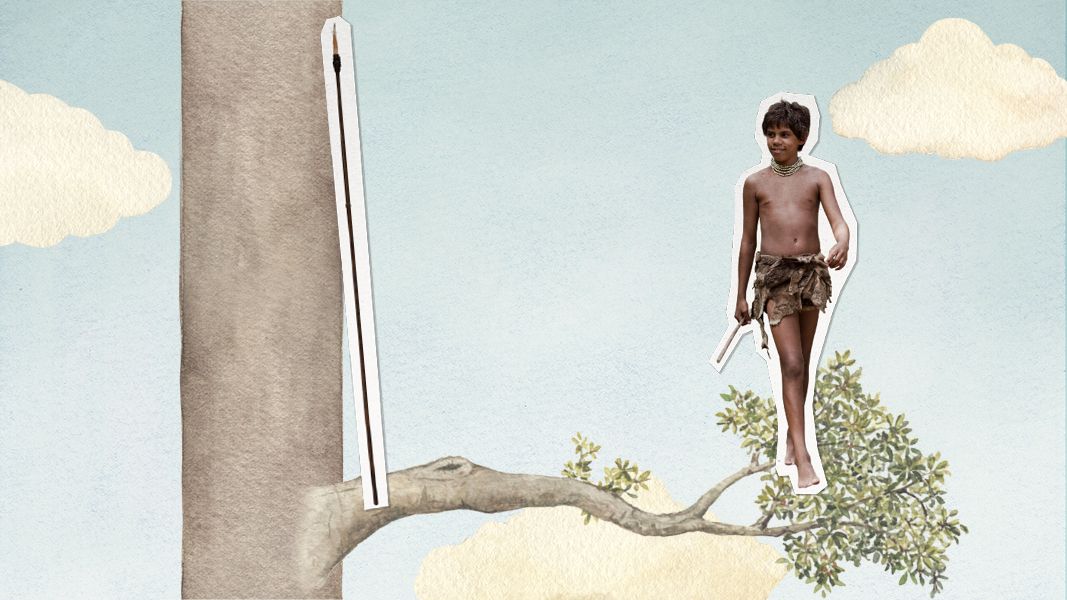
Before Time: Bunda
Bunda has a problem. His older brother Garadi acts like Bunda doesn't exist. Will they ever learn how to stop teasing each other and become friends as well as brothers?
The script for this episode, ‘Before Time: Bunda’, was written by Dallas Winmar in 2010. Dallas Winmar is a Noongar woman.
The stories and characters in this series are fictional, though some storylines are inspired by moments from history.
For the episodes 'Before Time: Bunda' and 'Before Time: Barangaroo', further context and support to the exploration of deep time can be found in the Deep Time Teacher Guide: Bunda & Barangaroo.
Deep Time Overview
This episode of My Place shifts to deep time histories of First Nations Peoples; stories grounded in tens of thousands of years of connection to Country, kinship, law and knowledge systems. The fictional story of Bunda invites students to understand the past not as a timeline beginning in 1788, but as a vast, continuous story shaped by the world’s oldest living cultures.
Deep time history requires respectful partnerships with local First Nations knowledge custodians. Where appropriate, work through established local community relationships to seek guidance from those with cultural authority about what knowledge can be shared. This approach ensures that teaching is culturally safe, accurate and grounded in community authority.
Deep time is not “long ago.” It is now, because Country continues to teach, guide and hold story.
Provocation Question
What does Bunda’s story reveal about how First Nations children learned through family, Country and responsibility, and what can we learn today from the way knowledge was shared across generations?
Clip 1: Snakebite
Bunda and Garadi are learning important knowledge from their father, knowledge that has been passed down for thousands of generations. As they learn about snakebite survival and spear-making, the cousins' competitive nature creates distractions that challenge their ability to focus on the lesson.
Tuning In
Bunda and Garadi are learning important knowledge from their father, knowledge that has been passed down for thousands of generations. As you watch, think about how the brothers learn, listen, and respond.
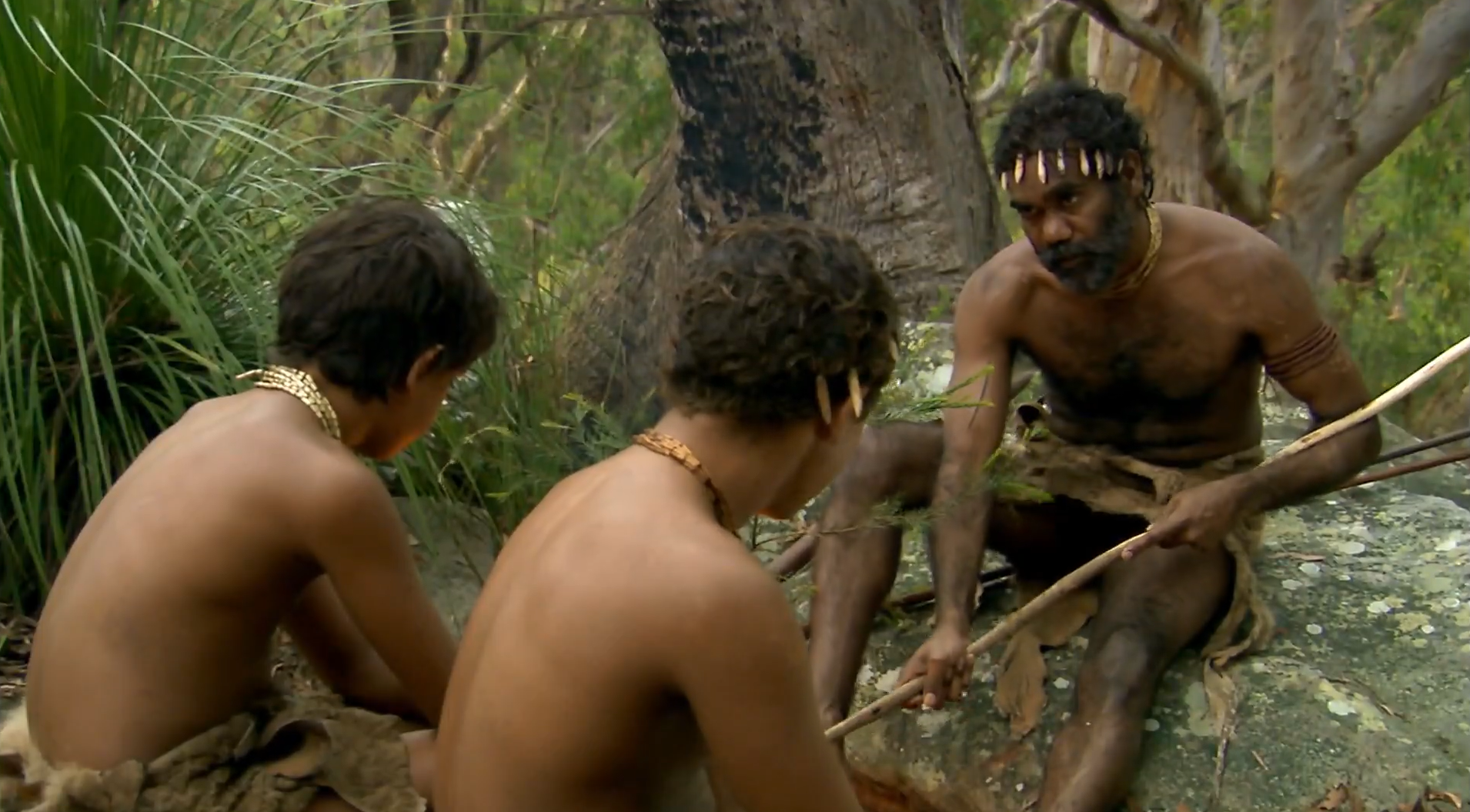
Use the above still image of the father teaching. As a class, record what you see, think and wonder in the below chart:
- See: What actions, tools, gestures do you notice?
- Think: What might these actions mean?
- Wonder: What questions do you have about how knowledge is taught?
| See: What we noticed | Think: What we think it means | Wonder: Questions we have |
|
|
Finding Out & Sorting Out
Ensure the resources you share are approved and shared from a First Nations organisation. For example, AIATSIS resources. This is also a great opportunity to find resources contextualised to the Country or Place your school is located on to make the learning more relevant for your students.
In small groups, investigate one of the following:
- Kinship
- Seasonal calendars
- Fire knowledge
- Water systems
- Tools and technologies
- Storywork and oral teaching
Use teacher-provided and locally relevant sources, such as AIATSIS resources, First Nations seasonal calendars, cultural burning case studies, images, videos and quotes, to build your understanding. If appropriate and available, invite a local First Nations community member to answer questions.
Create a Source Analysis Grid to organise your research:
- What knowledge is being shared?
- Who shares this knowledge?
- How is it passed down from one generation to the next?
- Why is this knowledge important?
- What evidence shows the role of Elders or knowledge holders in teaching others?
Once your group has completed its research, present a summary of your findings to the class. Then use the information gathered from each group to create a class concept map, wall display or graphic organiser that identifies:
- Similarities across the different groups research
- Different ways knowledge is passed from one generation to the next
- The role of Elders and knowledge holders in teaching and learning
- Why knowledge-sharing is important for maintaining culture and connection to Country
Making Connections
With a partner, discuss how Bunda and Garadi respond to their father's teachings in the clip.
Together, identify ways the brothers could show respect for the knowledge being shared. Use evidence from the clip and your research above to support your ideas.
Remember to:
- Refer to specific moments from the clip.
- Consider the importance of listening, responsibility and kinship you have learnt through your research.
- Explain how these values are reflected in the characters' actions and decisions.
Clip 2: Fishing
At the creek, Bunda's father tells him and his brother to catch a fish. Each uses a different method of fishing, and Bunda's method of building a small dam proves to be the most successful. Their father is annoyed that they are still not working together.
Tuning In
Bunda and Garadi are asked to catch a fish. They use different methods, both based on knowledge of Country. As you watch, think about how knowledge, teamwork and responsibility connect.
As a class, use the Thinking Routine: Connect > Extend > Challenge to organise your ideas:
- Connect: What does this remind me of?
- Extend: What new ideas do I have about knowledge and teamwork?
- Challenge: What questions do I have about the brothers’ choices?
Finding Out & Sorting Out
Work in small groups to investigate how knowledge is passed from one generation to the next.
Choose one knowledge system to research:
- Water systems (fish traps, eel traps and dams)
- Seasonal knowledge
- Tool-making
- Reading Country and waterways
Use teacher-provided and locally relevant sources to build your understanding. If appropriate and available, invite a local First Nations community member to answer questions.
Share your research with the class and then return to the clip and discuss:
- What is Bunda's father trying to teach the brothers?
- What happens when the brothers stop listening or working together?
- Why might this knowledge be important for people living on and caring for Country?
As a class, create a Learning Connections Map showing the relationship between:
Elders and Knowledge Holders > Teaching > Listening and Learning > Caring for Country
Use examples from both your research and the clip to support your ideas.
Making Connections
In this partner task, you will reflect on how Bunda and Garadi’s lack of teamwork influenced their ability to succeed when their father gave them a task. Think, Pair and Share ideas with your partner to design a Collaborative Fishing Plan, based on evidence from your research.
Design a fishing plan that:
- Uses ecological knowledge
- Respects Country
- Shows teamwork
- Reflects cultural values
Cite at least two pieces of evidence from your research.
Clip 3: Water
Bunda and his brother Garadi are competing with each other to find the best method of transporting water. Bunda constructs a raft to carry the water down the river, while his brother carries his water on foot. Bunda's father then tells his sons to bring him something that takes two to get, encouraging them to learn to work together.
Tuning In
The brothers try different ways to carry water. Their father gives them a challenge that requires cooperation. As you watch, think about what the father is really teaching.
- How each brother chooses to carry the water
- How they react to each other’s ideas
- What the father does or says that hints at the real lesson
- How the brothers move through Country and use what’s around them
Class discussion prompts:
- What does this moment show about learning from Elders and listening carefully?
- What cultural values might the father be teaching through this challenge?
- Why might “something that takes two” be important in their community?
- How does this scene help us understand responsibility, cooperation and kinship?
Finding Out & Sorting Out
Work with a partner to explore the father's challenge: "Find me something that takes two."
Create a simple table with these headings:
| What Bunda Did Alone | What Garadi Did Alone | What They Could Do Together |
Use evidence from the clip to complete the table, then discuss:
- What was the father trying to teach his sons?
- Why is working together sometimes better than working alone?
Making Connections
Explore how cooperation, cultural knowledge and respect shape this moment.
In small groups, discuss one of the following ideas:
- Working together
- Sharing responsibility
- Learning through doing
- Learning from Elders
Then return to the father's challenge: "Find me something that takes two."
Create a Values, Actions and Lessons chart:
| Value | What the brothers did | What they learned |
|---|---|---|
| Cooperation | ||
| Responsibility | ||
| Respect | ||
| ... | ||
| ... |
Use evidence from the clip to complete your chart.
Finish by writing a short response to the following question. What lesson is the father teaching the brothers, and why is it important for living and working together?
Australian Curriculum Links
|
|
Year 3 |
Year 4 |
Year 5 |
Year 6 |
Knowledge and Understanding - History |
|
the diversity of First Nations Australians, their social organisation and their continuous connection to Country/Place
|
|
|
Knowledge and Understanding – Geography |
the ways First Nations Australians in different parts of Australia are interconnected with Country/Place
|
|
|
|
Understanding – Civics and Citizenship |
why people participate within communities and how students can actively participate and contribute to communities |
|
|
|
Skills – Questioning and Researching |
develop questions to guide investigations about people, events, places and issues locate, collect and record information and data from a range of sources, including annotated timelines and maps |
develop questions to guide investigations about people, events, places and issues locate, collect and record information and data from a range of sources, including annotated timelines and maps |
|
|
Skills - Interpreting, analysing and evaluating |
analyse information and data, and identify perspectives |
analyse information and data, and identify perspectives |
|
|
Skills - Concluding and decision-making |
draw conclusions based on analysis of information actions |
draw conclusions based on analysis of information
|
|
|
Skills - Communicating |
present descriptions and explanations, using ideas from sources and relevant subject-specific terms |
present descriptions and explanations, using ideas from sources and relevant subject-specific terms |
present descriptions and explanations, drawing ideas, findings and viewpoints from sources, and using relevant terms and conventions |
present descriptions and explanations, drawing ideas, findings and viewpoints from sources, and using relevant terms and conventions |
|
|
Year 3 |
Year 4 |
Year 5 |
Year 6 |
Language |
|
understand how to move beyond making bare assertions by taking account of differing ideas or opinions and authoritative sources |
|
|
Literature |
discuss characters, events and settings in different contexts in literature by First Nations Australian, and wide-ranging Australian and world authors and illustrators
|
|
identify aspects of literary texts that represent details or information about historical, social and cultural contexts in literature by First Nations Australian, and wide-ranging Australian and world authors |
|
Literacy |
recognise how texts can be created for similar purposes but different audiences use interaction skills to contribute to conversations and discussions to share information and ideas plan, create, edit and publish imaginative, informative and persuasive written and multimodal texts, using visual features, appropriate form and layout, with ideas grouped in simple paragraphs, mostly correct tense, topic-specific vocabulary and correct spelling of most high-frequency and phonetically regular words plan, create, rehearse and deliver short oral and/or multimodal presentations to inform, express opinions or tell stories, using a clear structure, details to elaborate ideas, topic-specific and precise vocabulary, visual features, and appropriate tone, pace, pitch and volume |
compare texts from different times with similar purposes and audiences to identify similarities and differences in their depictions of events listen for key points and information to carry out tasks and contribute to discussions, acknowledging another opinion, linking a response to the topic, and sharing and extending ideas and information plan, create, edit and publish written and multimodal imaginative, informative and persuasive texts, using visual features, relevant linked ideas, complex sentences, appropriate tense, synonyms and antonyms, correct spelling of multisyllabic words and simple punctuation
plan, create, rehearse and deliver structured oral and/or multimodal presentations to report on a topic, tell a story, recount events or present an argument using subjective and objective language, complex sentences, visual features, tone, pace, pitch and volume
|
describe the ways in which a text reflects the time and place in which it was created use appropriate interaction skills including paraphrasing and questioning to clarify meaning, make connections to own experience, and present and justify an opinion or idea plan, create, edit and publish written and multimodal texts whose purposes may be imaginative, informative and persuasive, developing ideas using visual features, text structure appropriate to the topic and purpose, text connectives, expanded noun groups, specialist and technical vocabulary, and punctuation including dialogue punctuation plan, create, rehearse and deliver spoken and multimodal presentations that include relevant, elaborated ideas, sequencing ideas and using complex sentences, specialist and technical vocabulary, pitch, tone, pace, volume, and visual and digital features |
examine texts including media texts that represent ideas and events, and identify how they reflect the context in which they were created use interaction skills and awareness of formality when paraphrasing, questioning, clarifying and interrogating ideas, developing and supporting arguments, and sharing and evaluating information, experiences and opinions plan, create, edit and publish written and multimodal texts whose purposes may be imaginative, informative and persuasive, using paragraphs, a variety of complex sentences, expanded verb groups, tense, topic-specific and vivid vocabulary, punctuation, spelling and visual features plan, create, rehearse and deliver spoken and multimodal presentations that include information, arguments and details that develop a theme or idea, organising ideas using precise topic-specific and technical vocabulary, pitch, tone, pace, volume, and visual and digital features |
Aboriginal and Torres Strait Islander Histories and Cultures
Country/Place
Students explore the deep connections First Nations Peoples have with Country through Bunda and Garadi's use of ecological knowledge, including understanding water, animals and the environment. The lesson shows how Country acts as a teacher, with knowledge learned through observation, experience and responsibility.
Culture
Students examine how cultural knowledge is passed between generations through observation, storytelling, practical experience and guidance from Elders. The lesson highlights the importance of kinship, cooperation and shared responsibility in First Nations cultures.
People
Students investigate how identity and belonging are shaped by relationships with family, community, culture and Country. Through Bunda and Garadi's roles as learners and their father's role as teacher, students explore the responsibilities that come with kinship and community membership.
Critical and Creative Thinking
Students investigate how First Nations knowledge systems work, analyse the consequences of Bunda and Garadi's choices, and use evidence from research to interpret the cultural teachings embedded in their father's lessons.
Ethical Understanding
Students explore values such as responsibility, cooperation, respect and listening, and consider how these cultural responsibilities shape individual actions and relationships within a community.
Intercultural Understanding
Students develop intercultural understanding by examining First Nations ways of learning, teaching and sharing knowledge, and recognising the strength and sophistication of cultural practices that have been maintained over thousands of generations.
Personal and Social Capability
Students build personal and social capability by reflecting on teamwork, communication, conflict resolution and the responsibilities that come with belonging to a family and community.