Episode description: Klara and Pim have their suspicions confirmed – their father is not coming back. They struggle to deal with their grief, and it threatens to overwhelm them. Grandma and Grandpa step in to help out. Grandpa helps Pim deal with loss and disappointment by taking him moon fishing in the night sky, and Grandma creates a safe space for Klara to let her feelings out.
Context note: The Moonfish story comes from a different Shaun Tan book: Tales from the Inner City, a collection of stories about relationships between humans and animals.
Watch Episode 7: ‘Moonfish’ on ABC iView or download to own from the ACTF Shop.
Learning intention: Explore how visual storytelling, sound and open-ended narrative invite audiences to imagine, question, and co-create meaning.
Activity 1: Story spaces
Reflect
As Shaun Tan reminds us, Tales from Outer Suburbia leaves space for our imaginations:
And there's a lot of empty space, which sounds like a negative thing, but I find that's what really makes stories work, is those gaps, where it's actually very respectful to the audience and saying, you're an intelligent, creative dreamer. You add in your interpretation here and ask your own questions and see that we're not gonna tell you what we think about it, because it might not fit.
As a class, discuss the following questions and record key ideas on the board:
What do you think Shaun Tan means by ‘empty space’ in a story?
Why might a creator choose not to explain everything?
How is this different from stories that clearly tell us what everything means?
What other print or screen stories can you think of that leave gaps for the reader/viewer to fill in with their imagination?
Now think specifically about the episode 'Moonfish', and discuss:
What does it mean to be treated as an ‘intelligent, creative dreamer’?What ‘empty space’ did you notice in this episode?
How does this ‘empty space’ affect you as a viewer. Does it slow you down? Make you think and feel more deeply?
How would explanations and answers change the episode and your feelings about it?
In what ways were you actually doing some of the storytelling when you watched ‘Moonfish’?
Explore
This independent writing activity invites you to step into the story as a co‑creator. Shaun Tan encourages us to ask questions instead of looking for fixed answers. After watching the episode, pause and notice what stayed with you. Think about:
how the episode made you feel.
moments that sparked your curiosity.
images, sounds or characters that felt mysterious.
parts of the world the episode did not explain.
Choose 3 - 5 questions that interest you and jot them down. There are no wrong questions. You may share them or keep them private. Now select one question and explore it further. Sit with the idea and notice what it opens up for you. You might think about why it matters, what it connects to, or what it makes you imagine. Treat your question like the centre of a map. Around it, add words, sketches, symbols or rough ideas. Your response does not need to explain the episode. It simply shows how you help shape the story by thinking, wondering and imagining like a co‑creator.
Activity 2: The Night Chef
Explore
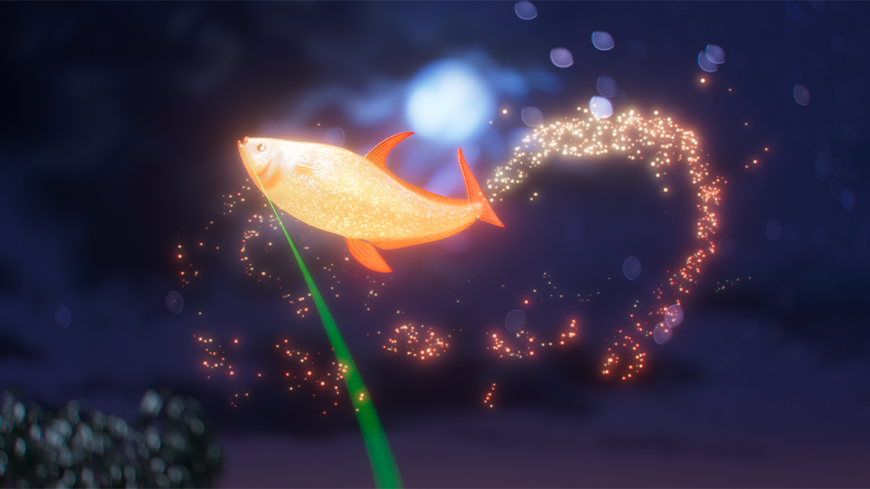
Watch the scene above showing the Moonfish being taken to the mysterious Night Chef. Take a close look at the techniques and screen language that make the scene feel so powerful. The scene uses very little dialogue, so pay attention to how images, sound and atmosphere help tell the story without explaining it. Working with a partner discuss:
What stood out to you in this scene
The feelings evoked/created
The characters
The setting
How lighting and colour affect the mood of the scene
The different shots used
The use of sound
Use the worksheet below to organise and record your responses.
After you have spent time analysing the scene with a partner, share your discoveries as a class. Try freeze-framing shots to dig even deeper.
Activity 3: Communicating emotion
Reflect
Klara and Pim are carrying feelings of grief and loss as they adjust to the absence of their father and the life they once knew. Big emotions like these can be difficult to explain or put into words. In this episode, their feelings are shared in quieter ways, through what happens in the story and through the use of image, sound and atmosphere.
As a class, explore how the characters’ emotions are communicated to the audience. Notice how feelings are shown rather than spoken and discuss:
Klara and Grandma’s conversation
Pim’s response to his father’s absence
Pim’s feelings about the moonfish
Esme’s drawings
Cat’s flickering film
You may find it helpful to rewatch short moments from the episode as you talk together. Why do you think the creators chose to show emotions through these events, images and techniques? How do these choices reflect what you have learned about Shaun Tan and his approach to storytelling, where meaning often grows through feeling, suggestion and imagination rather than clear explanations?
Create
Choose one character from the episode and find a creative way to show how they are feeling in a specific moment. You might even like to choose the Night Chef. Select one of the activities below to share the character’s emotions and inner world:
Write a short diary entry or letter that captures what the character might be thinking or feeling.
Create a storyboard or comic that shows the character expressing or sharing emotions through actions and moments.
Draw, sketch or paint a scene that reveals the character’s feelings. Think about how colour, shape and perspective can help communicate mood to the viewer.
Your response does not need to explain everything. Focus on helping the audience feel what the character is experiencing.
Create
When Klara feels like everything is too much and she is starting to drown in her emotions, her living room begins to fill with water. This visual moment symbolises how overwhelming her feelings have become and how there is no space left to breathe or think clearly.
Imagine a character’s feelings beginning to shape the world around them. Create a short story, animation or artwork that shows how the world looks, sounds or behaves when that emotion takes over. Think about how the feeling might change the environment, the mood or even the rules of this place. Let the emotion guide what unfolds on the page or on screen, rather than explaining it in words.
Activity 4: Page to screen
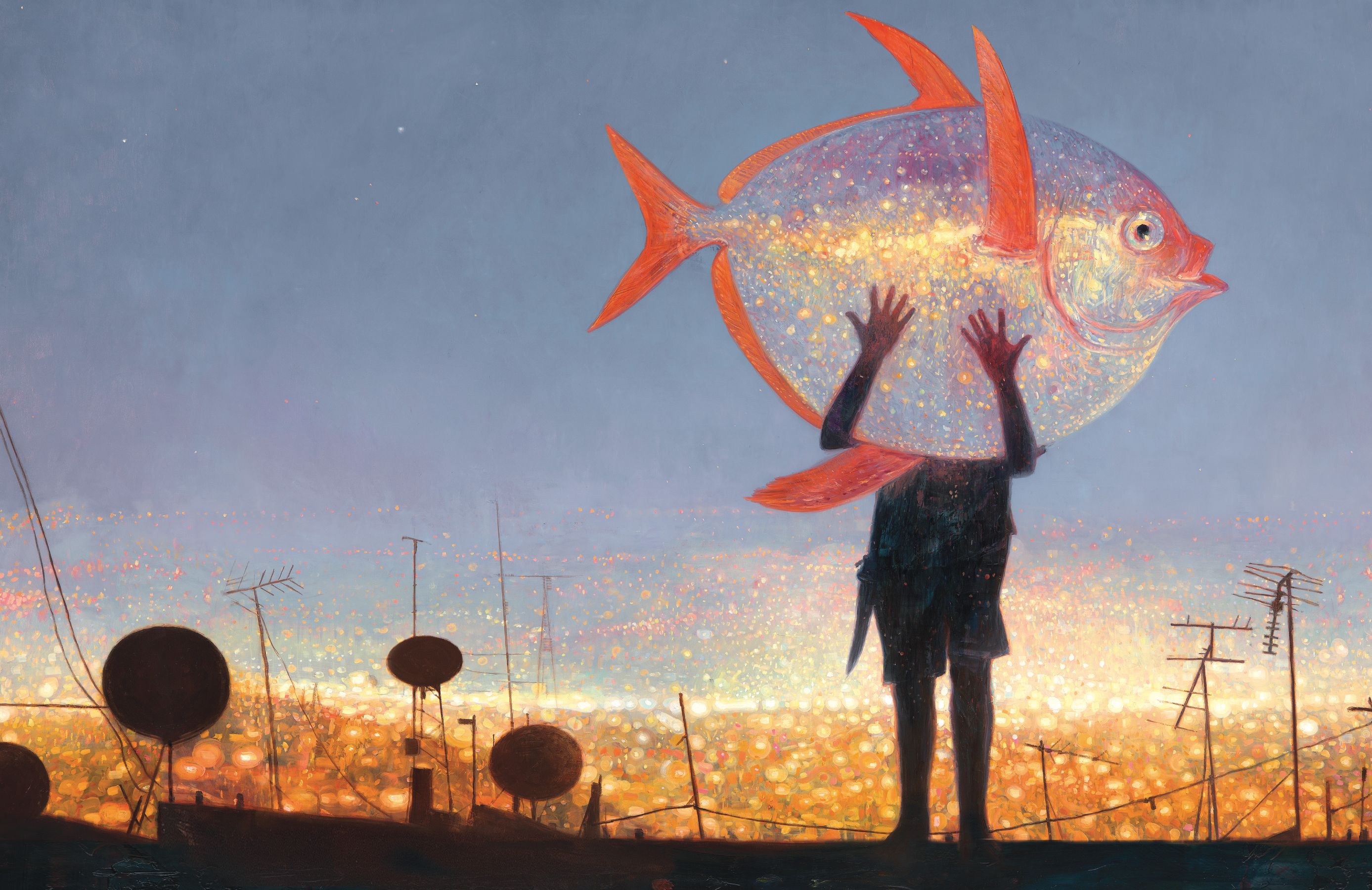
The episode 'Moonfish' is inspired by a story from Shaun Tan’s book of stories Tales from the Inner City (2018). Of the 25 stories in this anthology, he writes:
The basic premise I set for myself was quite simple: think about an animal in a city. Why is it there? How do people react to it? What meaning does it suggest?
Tales from the Inner City, page 92 - 93. Courtesy of Allen and Unwin.
Reflect
Work in pairs to explore the artwork above. Take your time to look closely and talk together about what you notice. Jot down ideas as you go, as you will use these notes for your individual written response. Discuss:
How does this artwork make you feel? What might be causing that feeling?
What does the image make you think about or notice? Why?
Look closely at the city beneath the Moonfish. Which details catch your eye?
How would you describe the Moonfish itself, including its size, shape and expression?
What do you notice about the light, colour or texture used in the artwork?
Which elements create a sense of wonder, mystery or unease?
Focus on sharing impressions and ideas rather than finding right answers.
Explore
Shaun Tan’s Moonfish artwork above inspired the Moonfish depicted in the episode, both in its appearance and in the feelings it creates in the audience. Using your discussion notes compare the two Moonfish and consider:
What is similar about the Moonfish in the book and the episode, in both appearance and mood?
How do the feelings created by the Moonfish artwork compare with how the Moonfish made you feel in the episode?
What differences do you notice in the screen version of the Moonfish? Why might the creators have made these choices?
In the artwork, the Moonfish appears above an inner‑city setting, while in the episode it appears in the suburbs. How does this setting change the feeling the creature creates?
Activity 5: Behind the scenes
Reflect
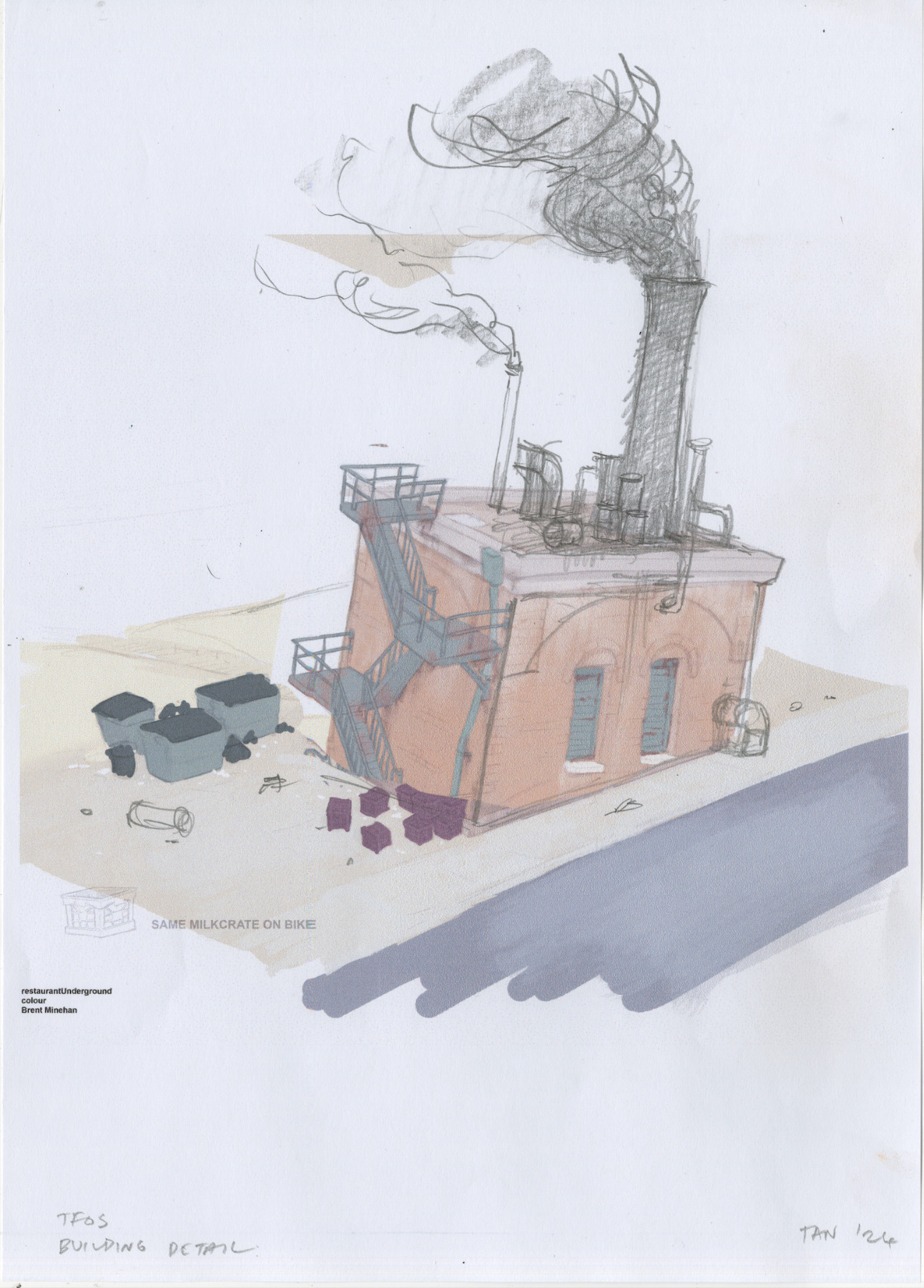
In a number of episodes, the characters leave the world of outer suburbia and find themselves somewhere completely different. In this episode, Lucy, Pim and Grandpa head off to visit the Night Chef in a restaurant that is a long way from their familiar surroundings. Here you can see a sketch done by Shaun Tan exploring ideas for the episode.
Factory sketch. Artist: Shaun Tan.
This sketch was shaped by Shaun Tan’s early ideas about mood, space and feeling. Rather than focusing on neat explanations, these notes below which were written on the concept artwork reveal how he imagined the setting as something you enter emotionally as well as physically, a place that feels unsettling, hidden and alive.
Thought: why not make the restaurant building sunken into the ground, more apparently derelict, yet with active chimneys on top (as a restaurant must have), vents and intakes, and an ominous furnace, think Spirited Away. Lower, to give more sense one goes underground. Entry through top as door submerged. More broken junk could be scattered around. All very ominous.
– Shaun Tan, notes on concept art
Create
Imagine a place that feels unfamiliar, unsettling and slightly hidden from everyday life. Create a concept sketch of an unseen location such as an abandoned school, a forgotten factory or an empty warehouse. Draw the building from the outside and show how it is entered. Include small details that suggest it is still active, like lights, chimneys, vents or distant sounds, as well as objects or scattered junk that hint at its history. Add short annotations to explain your choices, inspired by Shaun Tan’s sketch notes and thinking process.
Create a short storyboard that follows characters as they move from a familiar suburban setting into your unseen place. Draw 4 - 6 panels that show:
Ordinary suburban setting
The journey away
First glimpse of the strange place
Entry into the location
Use strong contrasts to highlight the shift between places, such as light/dark or clean/dirty, new/worn-out, orderly/chaotic, and let the mood of each setting guide your drawings.