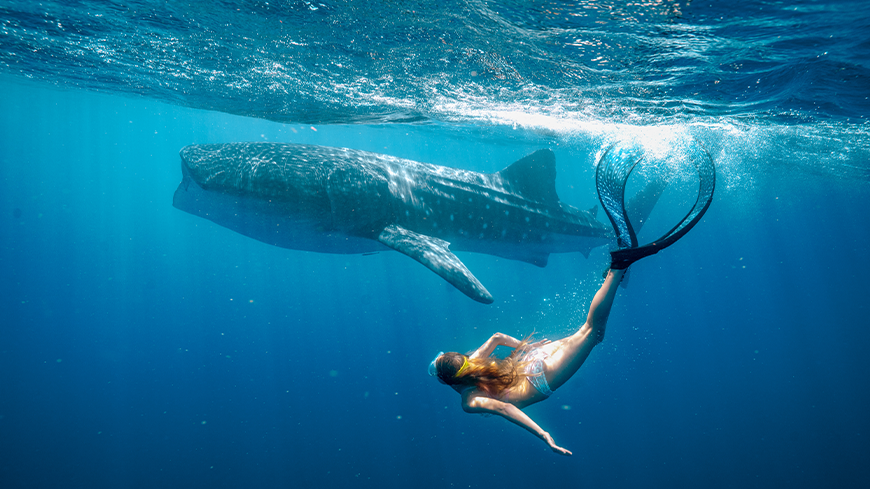
Whale sharks and marine science
Learning intention: Investigate whale sharks and their role in marine ecosystems, explore how scientists and filmmakers use evidence, technology and creativity to understand the natural world, and consider how we can help protect important ocean habitats.
Become a marine scientist, researcher and creator as you investigate whale sharks and the Nyinggulu (Ningaloo) Coast. Through research, design and reflection activities, you'll explore marine ecosystems, conservation and the connections between people and the ocean. These activities was developed in collaboration with the Western Australia Museum Boola Bardip.
Activity 1: What is a whale shark?
Reflect
Before conducting any research, reflect on what you already know about whale sharks from the film.
Discuss:
- What do we learn about whale sharks from the film?
- What do whale sharks look like?
- Where do they live?
- What questions do you still have about whale sharks?
As a class, create a Wonder Wall. Record interesting facts students already know and collect questions they would like to investigate. For example:
- How big can a whale shark grow?
- What do whale sharks eat?
- How do scientists track whale sharks?
- Are whale sharks endangered?
Explore
Whale sharks are the largest fish in the world, yet they feed on some of the smallest marine organisms. Working in small groups, investigate whale sharks and gather information about:
- their physical characteristics
- habitat and migration patterns
- diet and feeding behaviour
- life cycle
- threats to their survival
- their role within ocean ecosystems
Teacher note: These sources provide reliable introductory information about whale shark biology, habitat, behaviour and conservation.
- Western Australia Museum Boola Bardip: Meet the Whale Shark
- WA Department of Biodiversity, Conservation and Attractions: Whale Shark Management in Western Australia
- WA Department of Biodiversity, Conservation and Attractions: Whale Shark Information Booklet (PDF)
- Australian Institute of Marine Science: Whale Sharks
- WA Government Marine Waters: Whale Shark Fact Sheet
As you research, think about why whale sharks are often considered an indicator of a healthy marine environment. How might changes to ocean ecosystems affect them?
Create
Create a Whale Shark Fact File to showcase your learning.
Include:
- a labelled illustration or diagram
- five to ten key facts about whale sharks
- a map showing where whale sharks can be found
- an explanation of their role in the marine ecosystem
- one interesting fact that surprised you during your research
When finished, compare your findings with your original questions. Which questions have been answered? What new questions do you have about whale sharks, marine science or ocean conservation?
Create
Marine scientists rely on observation, data collection and research to better understand animals and their habitats.
Imagine you are a marine scientist studying whale sharks along the Nyinggulu (Ningaloo) Coast. Write a field journal entry describing a day in the field. What observations would you make? What data would you collect? What questions would you hope to answer through your research?
Activity 2: Bringing whale sharks to the screen
Reflect
In Whale Shark Jack, audiences meet whale sharks that feel believable, expressive and connected to the story. Creating these characters required filmmakers to work closely with scientific information while also making creative decisions.
Watch the behind-the-scenes clip:
As you watch, think about the challenges involved in bringing a whale shark to the screen.
Discuss:
- What information did filmmakers use to design the whale sharks?
- How did science influence the creative process?
- What role did technology play in creating realistic whale shark characters?
- Why was designing a baby whale shark particularly challenging?
- How did filmmakers balance scientific accuracy with storytelling?
After watching, consider this question:
When creating an animal for a film, is it more important to be scientifically accurate or visually engaging? Why?
Behind the scenes
Explore
Scientists know a lot about adult whale sharks, but baby whale sharks remain one of the ocean's great mysteries. Very few have ever been observed in the wild, which means filmmakers had limited information when designing the young whale shark featured in Whale Shark Jack.
Review the information you discovered in Activity 1 and identify the scientific clues that might help filmmakers imagine what a baby whale shark could look like.
Consider:
- How might a baby whale shark differ from an adult?
- Which features would likely stay the same?
- How might it move through the water?
- What colours, patterns or markings might it have?
- What behaviours might it display?
Discuss how filmmakers can use scientific evidence to guide their creative decisions when complete information is unavailable.
Create
Design a baby whale shark character.

Using what you have learned about whale sharks, create your own interpretation of a baby whale shark.
Your design should be informed by scientific understanding while also using your imagination to fill gaps in knowledge.
Include:
- a labelled sketch or digital illustration
- a name for your whale shark
- notes explaining key design choices
- details about its appearance, movement and behaviour
- an explanation of how science influenced your design
When finished, present your character to the class and explain which features were based on scientific evidence and which required creative thinking.
Compare your designs with those created by your classmates.
Discuss:
-
Which design choices appeared in multiple whale sharks?
-
Where did creative interpretations differ?
-
How did scientific knowledge help shape each design?
-
What challenges did you face when designing an animal that has rarely been seen in the wild?
Reflect on how filmmakers, scientists and artists often work together to help audiences understand and connect with the natural world.
Activity 3: Tracking life in the ocean
In Whale Shark Jack, our characters work to learn more about whale sharks and their movements through the ocean.
Watch the compilation from the film below in which the characters explain how whale sharks are tracked.
As you watch, consider:
- Why do they need to track whale sharks?
- What information might tracking reveal?
- How could this information help protect whale sharks and their habitat?
Explore
Whale sharks travel vast distances across the world's oceans. Because they spend much of their time underwater, scientists use a range of technologies to learn more about where they go and how they live.
Research some of the methods used to study whale sharks, including:
- satellite tags
- acoustic tags
- photo identification
- community sightings and citizen science projects
Teacher note: Students can investigate how scientists use satellite tags, acoustic tags, photo identification and citizen science projects to monitor whale shark populations and migrations.
- ECOCEAN Whale Shark Research and Conservation Centre
- Sharkbook AI
- Atlas of Living Australia: Whale Shark Records
- WA Department of Biodiversity, Conservation and Attractions: Whale Shark Management in Western Australia
- CSIRO Ningaloo Outlook: Whale Sharks
- WA Marine Science Institution: Population Monitoring Protocols for Whale Sharks
- WAMSI Whale Shark Factsheet (PDF)
One surprising method involves using the unique spot patterns on each whale shark. Like a fingerprint, no two whale sharks have exactly the same pattern. Scientists can compare photographs to identify individual animals and monitor them over time. Explore:
- How does photo identification work?
- Why is it useful for scientists?
- What are the advantages and limitations of different tracking methods?
You may like to investigate:
- Whale Shark Management in Western Australia
- ECOCEAN and Sharkbook
- Atlas of Living Australia whale shark records
Activity 4: Nyinggulu (Ningaloo Reef)
Reflect
The story of Whale Shark Jack is deeply connected to the Nyinggulu (Ningaloo) Coast, one of Australia's most remarkable marine environments.
For thousands of years, the Baiyungu, Thalanyji and Yinigurdira peoples have cared for this Country and Sea Country. Whale sharks are known as Gujawari by Traditional Owners of the region.
Thinking about what you have seen of the Nyinggulu (Ningaloo) Coast from the film, discuss:
- What makes this environment unique?
- What marine animals can be seen in the film?
- How might people and marine environments be connected?
Explore
Ningaloo Reef is one of the world's largest fringing coral reefs and supports an extraordinary diversity of life. Working in small groups, investigate one aspect of the ecosystem:
- coral reefs
- manta rays
- sea turtles
- reef fish
- seabirds
- plankton
Teacher note: Encourage students to explore the environmental, cultural and scientific significance of the Nyinggulu (Ningaloo) Coast. The DBCA booklet also introduces the name Gujawari, the name given to whale sharks by Traditional Owners, and recognises the Baiyungu, Thalanyji and Yinigurdira peoples as the Traditional Custodians of the Nyinggulu (Ningaloo) Coast.
- WA Department of Biodiversity, Conservation and Attractions: Whale Shark Management in Western Australia
- WA Department of Biodiversity, Conservation and Attractions: Whale Shark Information Booklet (PDF)
- CSIRO Ningaloo Outlook Project
- CSIRO Ningaloo Outlook: Whale Sharks
- Western Australia Museum Boola Bardip: Meet the Whale Shark
- Australian Institute of Marine Science: Whale Sharks
- WA Marine Science Institution: Population Monitoring Protocols for Whale Sharks
As you research, consider:
- What role does your organism play in the ecosystem?
- What does it depend on for survival?
- What other species depend on it?
Create a simple ecosystem diagram that shows the connections between organisms living in and around the reef.
Create
Build a Ningaloo Ecosystem Web. Using string, arrows or a digital tool, create a visual representation of the relationships within the reef ecosystem. Your model should show:
- producers, consumers and decomposers
- feeding relationships
- connections between species
- the role of habitats such as coral reefs and seagrass meadows
Create
Once you have completed your ecosystem web introduce a scenario such as:
- ocean warming
- coral bleaching
- increased pollution
- declining whale shark numbers
Discuss how changes to one part of the ecosystem could affect the whole system.
Activity 5: Protecting what matters
Reflect
Throughout Whale Shark Jack, you have explored whale sharks, the Nyinggulu (Ningaloo) Coast, marine science and the ways stories can help us understand and connect with the world around us.
Bring the class together to reflect on your learning. Discuss:
- What is the most interesting thing you learned about whale sharks?
- What surprised you about the work of marine scientists?
- Why is the Nyinggulu (Ningaloo) Coast an important habitat for whale sharks and other marine life?
- How did Whale Shark Jack help you learn about science, conservation and the natural world?
- Why is it important to protect marine ecosystems for future generations?
Create
As a class, create a collective statement that completes the sentence:
"We care about whale sharks because..."
Display your statement in the classroom as a reminder of how science, storytelling and creativity can work together to help people understand and protect the natural world.