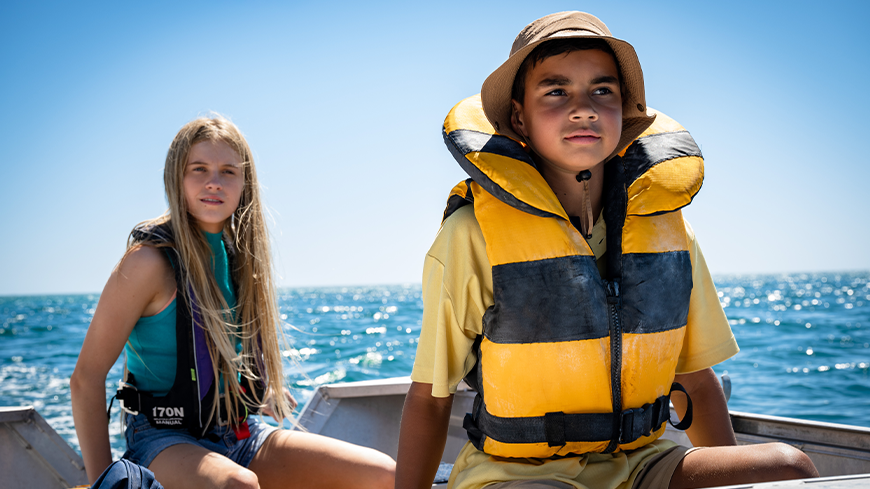
Before watching Whale Shark Jack
Learning intention: Understand key contextual ideas about the Nyinggulu (Ningaloo) Coast, Country, culture and the ocean to support viewing and understanding of Whale Shark Jack.
Set on the Nyinggulu (Ningaloo) Coast and in its surrounding waters, Whale Shark Jack is an adventure story that celebrates the ocean, its unique environment and the people connected to this special place. As Sarah's journey unfolds, the film also explores loss, healing, friendship and belonging.
Activity 1: The ocean, beauty, power and connection
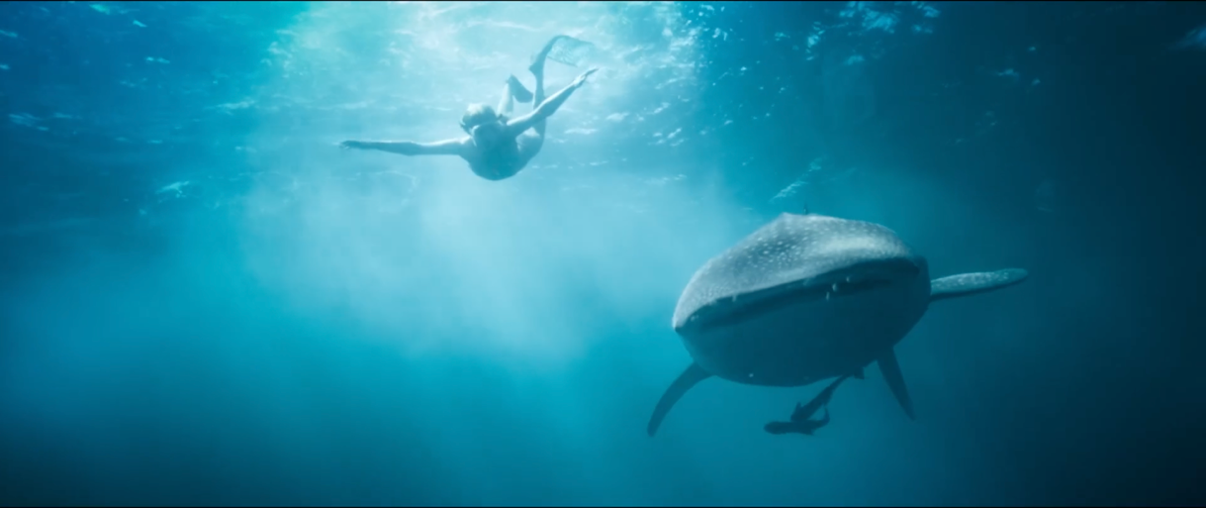
Reflect
Look at this image from Whale Shark Jack and then write three words that capture what the ocean means to you. These might be words about feelings, memories, experiences or ideas. You can draw on your own experiences, things you have seen or learned, or your imagination.
Share responses as a class and create a collective ocean word bank. Discuss:
- What ideas appear most often?
- Are there words that surprise you?
- Why does the ocean create such strong feelings and responses?
- Why might people feel connected to the ocean even if they have never lived near it?
- How do our experiences influence the way we see the ocean?
As you watch Whale Shark Jack, consider how the film explores the importance of the ocean to people, animals and communities. Notice whether your understanding of the ocean stays the same or changes as the story unfolds.
Explore
Begin by locating the Nyinggulu (Ningaloo) Reef on a map of Australia. In which state or territory is it? Which towns are closest to the reef? How far is this area from where you live?
Working in small groups, research the Nyinggulu (Ningaloo) Reef. Find out:
- why Nyinggulu (Ningaloo) Reef is an important marine environment.
- what animals and plants depend on this ecosystem.
- why whale sharks visit the Nyinggulu (Ningaloo) Reef each year.
- what challenges are impacting the health of the reef.
Share your findings to create a class fact file about the reef.
When you watch the film, notice how the reef and ocean environment are represented through images, sound and storytelling.
Activity 2: Understanding Country and culture
Reflect
Whale Shark Jack is set on the Countries of the Baiyungu, West Thalanyji and Jinigudera Peoples around Exmouth and the Nyinggulu (Ningaloo) Reef. Before watching the film, take some time to learn more about the deep connections between First Nations peoples and Country.
Before beginning this activity, read the Common Ground resource What is Country?
What is Country? – Common Ground
Working in pairs:
- discuss what you learned from the Common Ground resource that deepened your understanding of Country. Record two or three key ideas.
- complete the sentence: “Country is more than a place because…”
After sharing your sentences as a class, discuss:
- the new and different ideas you learned about Country.
- the Country your school is located on, and how acknowledging Country shows respect for Traditional Owners and their knowledge, culture and ongoing care for Country.
- the importance of learning about a place from the perspectives and knowledge of its Traditional Owners.
Explore
Baiyungu Traditional Owner Hazel Walgar provided cultural guidance as Associate Producer and First Nations Advisor, supporting the respectful representation of Country, culture and community knowledge. She and her sister Gwen Peck wrote the healing song in Baiyungu language for the film.
Watch this behind-the-scenes video to learn more about Country, culture and language in Whale Shark Jack.
After watching the video, discuss:
- Hazel’s role in bringing Baiyungu language and culture to Whale Shark Jack.
- what you learned from Jayden Boundry (who plays Peter) and Ursula Yovich (who plays Hazel) about respecting the language of a different First Nations People.
- the different ways that First Nations culture is woven into the Whale Shark Jack story.
- why it is important for filmmakers to work with Traditional Owners when sharing stories connected to Country.
When you watch Whale Shark Jack, notice how Baiyungu culture, language and connection to Country are represented.