
Ideas and themes
Learning intention: Explore how Whale Shark Jack communicates ideas about people, relationships, belonging and the natural world.
In your study of Whale Shark Jack, you have examined how characters, relationships, setting and film language contribute to the story. You will now explore some of the important ideas the film communicates about relationships, belonging, grief and healing, and the connections between people and the natural world.
Activity 1: Sharing ideas and themes
Reflect
Powerful stories do more than tell us what happens. They invite us to think about bigger ideas. What big ideas about people, relationships, belonging, grief, nature or the world around us does Whale Shark Jack explore?
- Write down two or three ideas.
- Share your ideas with a partner. What ideas do you have in common? What ideas are different?
- As a class, share your ideas and create a collection of significant ideas and themes explored in the film.
Explore
Look at the collection of ideas and themes generated by the class. Can you find connections between the ideas?
In groups:
- Put similar ideas together, discuss whether some could be combined, and add any important ones that are missing.
- Choose three ideas that you think are at the heart of Whale Shark Jack. Discuss how these ideas are connected and why they are important to the film.
- Now become theme ‘detectives’. Look for clues in the film that help you explore your ideas. For each theme, find evidence from a scene, character, event and/or piece of dialogue.
- Use your evidence to explain and defend your ideas.
As a class
- Each group shares one idea and the evidence that helped them develop it.
- Consider how these different responses, add new perspectives and ways of thinking about the film.
Create
Use what you discovered during the ‘Explore’ activity to develop your own response to the film’s themes and ideas.
- Think about the different ideas, connections and perspectives shared by the class. How has your thinking about Whale Shark Jack changed or developed?
- Write a short paragraph about one idea you think is important in Whale Shark Jack. Use evidence from the film to explain what the film suggests about this idea and why it is significant.
Activity 2: Healing and belonging
Watch this clip where E. J.’s mother Hazel recognises Sarah’s grief and responds by singing a healing song. You might also like to review what you learned in the introductory section about the importance of Baiyungu culture in Whale Shark Jack.
Reflect
After watching the clip, take a moment to think about your personal response to this scene:
- What did you notice about the song and the way it was shared with Sarah?
- What effect did the song have on you as a viewer?
You may like to write down your thoughts, but you do not need to share with the class.
Explore
Whale Shark Jack draws on a Baiyungu perspective to communicate ideas about connection to Country, belonging and healing.
Write down your thoughts about these questions. Your teacher will collect and combine the responses to help the class consider different ideas.
- What do you think Hazel’s response to Sarah communicate about healing, care and connection?
- What does the film suggest about the ways people can support each other through grief and loss?
- The healing song returns during the film’s climax. What ideas from this scene help us understand what happens in the climactic scene?
As you listen to the different ideas, consider: What do we agree on? What is different? What does this help us notice about the film?
Create
Think about these two scenes together: Hazel sings the healing song to Sarah, and later Sarah uses the power of touch to help heal Jack.
Write a short response explaining how these two scenes help us understand Sarah’s journey through grief and towards healing?
In your response, you might consider:
- what you think Hazel’s song communicates to Sarah and the audience about healing and connection
- how these ideas return in the climactic scene
- what has changed for Sarah between the two scenes
- the importance of community and belonging in Sarah’s healing
Activity 3: People and the natural world
The activities in this sequence can be explored at different levels of depth. Teachers may select activities according to the needs, interests and prior knowledge of their students.
Reflect
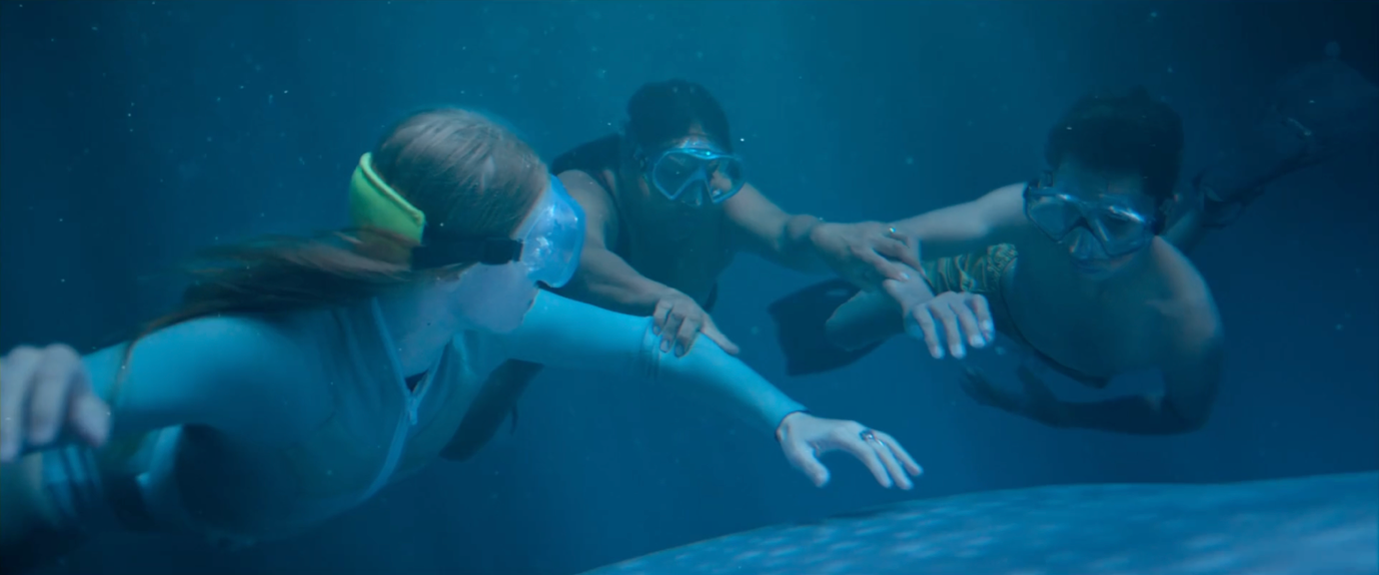
Hazel, E.J. and Sarah care for Jack
“Whale Shark Jack is a story inspired by our love of the ocean, and the deep belief that the natural world has the power to heal, to connect, and to transform us.”
– Miranda and Khrob Edmonds (directors)
Choose one word from the directors’ statement: heal, connect or transform.
Think about how this idea is explored in the film.
- What does the natural world give to the characters in Whale Shark Jack?
- Which moments in the film show this?
- What do these moments suggest about the relationship between people and the natural world?
Share your ideas with the class. Add examples under the three headings:
| Heal | Connect | Transform |
Explore
Sarah’s dad tells her: “Never think of yourself as too small to make a difference – ever.” And her mum adds: “I reckon everyone of us can make a difference.”
In portraying the characters’ connection to the ocean and their concern for whale sharks, Whale Shark Jack encourages viewers to think about how people can take responsibility for protecting marine life.
Think about the characters and events in Whale Shark Jack. Identify moments when a character:
- takes action to help a whale shark or protect marine life
- helps another person understand or care about whale sharks
- has an opportunity to make a difference.
Discuss:
- What do these moments suggest about our responsibilities towards marine life?
- What does the film suggest that one person can do?
Create
Design a class manifesto about our relationship with the natural world. A manifesto is a short statement of ideas or beliefs about how we should think or act.
Your manifesto should:
- express an idea about how people can connect with, care for and make a difference to the natural world
- draw on Whale Shark Jack
- include something from your own experience or observations
- encourage others to think differently.
You could begin with one of the following:
- We believe…
- We should…
- Everyone can…
- Our relationship with nature…
- Even one person can…
Then add a reason, example or call to action:
- This matters because…
- In Whale Shark Jack, we see this when…
- In our own lives…
- So we should…
- Imagine if everyone…
After you have created your class manifesto, work in groups to design a powerful way to present it to others. It could be a poster, spoken-word performance, combination of images and text, short video or another creative format.