Mission 5: Film a short spy sequence
Learning intention: We are learning to plan and create a story with a beginning, middle, and end, and to work together as a team to solve problems.
I can:
- plan a story using a beginning, middle, and end
- identify a problem and a solution in a story
- use toys to act out and create a simple film
- share ideas and listen to others in a group
- take turns and play a role in my team
For this lesson, students may be asked to bring a toy from home. If Lesson 4: Design a Knee-High Spy has been completed, encourage students to bring in the toy they used for their character profile.
For this lesson you will also need a device with camera. For example, a tablet or a laptop with a webcam.
Watch
Watch Episode 13 ‘Mission: Movie Mess’ (11 minutes) on ABC iView or download from the ACTF Shop.
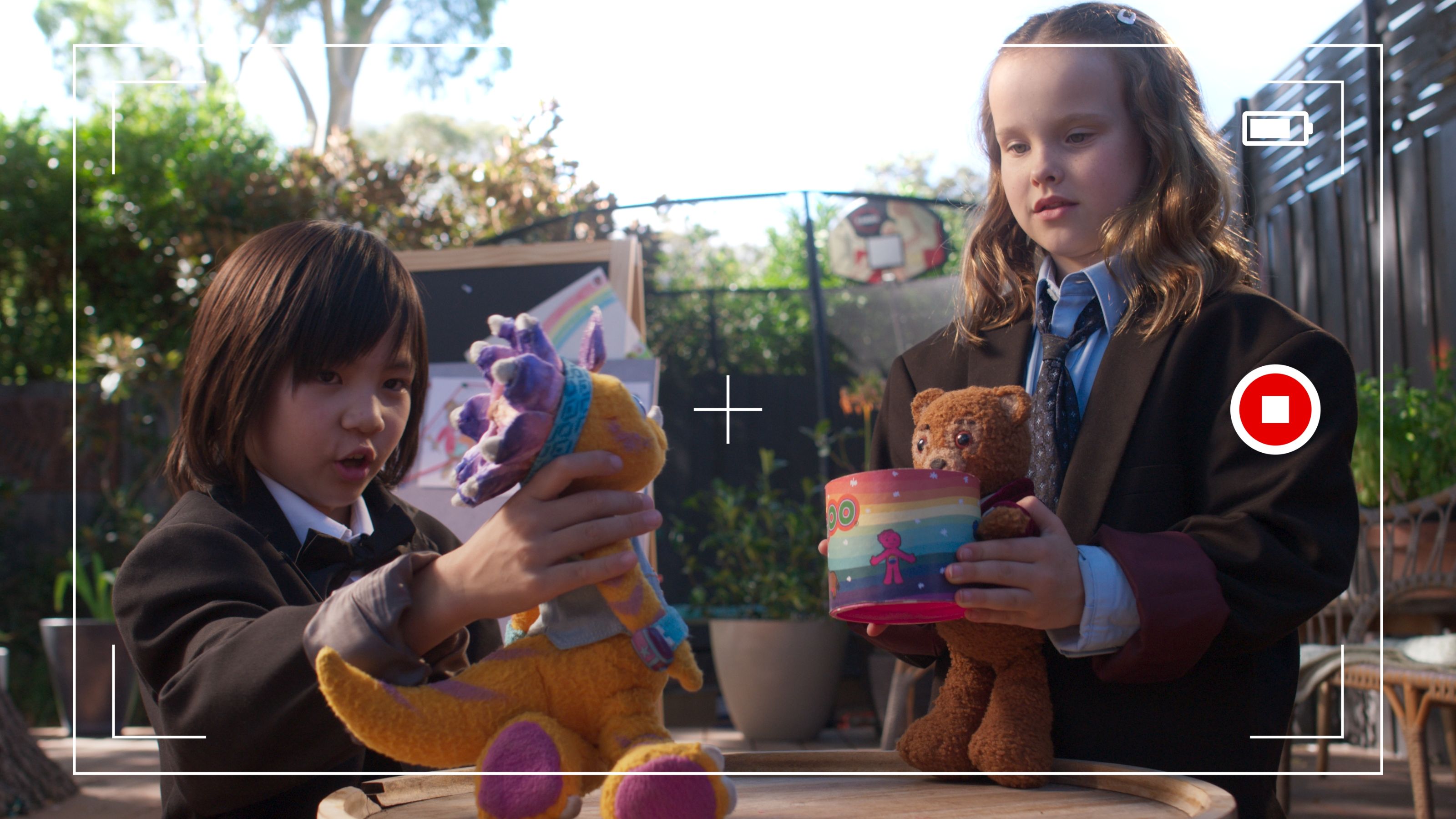
Lauchie and Scarlett are making a homemade movie with their toys in the backyard, but Silver Paw is determined to be the superstar.
Reflect
As a class, discuss the movie-making process shown in the episode. Prompt students with questions such as:
- How did Lauchie and Scarlett work together to make their movie?
- What problems did they encounter while filming?
- How were those problems solved?
Explore
On the board, demonstrate creating a 3 panel storyboard planning out a beginning, middle and end for a spy movie. You might like to project the following storyboard.
Before drawing, physically act out your idea using toys. Ask the class:
- Does my story make sense?
- Did we see the problem clearly?
- Is the solution connected to the problem?”
Encourage students to also physcially act out their story before beginining their storyboard.
Now draw the beginning, middle and end of your story on your storyboard. When drawing out the plan ask yourself the following questions aloud, and answer them for the class:
Panel 1 – Beginning
- Who is in the story?
- Where are they?
- What are they doing?
- How are they feeling?
Panel 2 – Middle (The Problem)
- What goes wrong?
- Who causes the problem?
- Why is it tricky?
Panel 3 – End (The Solution)
- How is the problem solved?
- Which strength helps fix it?
- How do the characters feel at the end?
Students work then work in small groups (2 - 3 students) to plan a short film using toys they have brought from home or selected from the classroom. Using the three-panel storyboard worksheet, students create a picture plan showing the beginning, middle and end of their film.
Roam the class as students work and assist as needed.
Create
Step 1: Mission Briefing
Gather students and speak in a dramatic “mission control” voice:
“Spies, it’s time to bring your storyboard to life! Just like Lauchie and Scarlett, you will work as a team to create your own spy movie. But remember — movies don’t work if everyone tries to be the boss. They work when everyone plays a part.”
Briefly revisit:
- What made Lauchie and Scarlett successful?
- What caused problems?
- How were those problems solved?
Write on the board:
Great filmmaking teams…
-
- Take turns
- Listen to ideas
- Solve problems calmly
- Share the spotlight
Encourage students to:
- Film in a quiet, well lit spot
- Do a practice before filming
- Hold the iPad steady.
- Speak clearly and loudly enough.
- Follow their storyboard order.
Students can either film as a 3-shot movie (one clip each for the beginning, middle, and end), or film their movie entirely in one shot.
Step 2: Begin filming
Circulate and ask thinking prompts:
- What part of the story are you filming?
- Is this the beginning, middle, or end?
- How does your character solve the problem?
- Does your film show teamwork like in the episode?
- Watch your video back, and check that it makes sense
If conflict arises, guide with reflective questioning:
- What would the Knee High Spies do?
- How can we make sure everyone feels included?
Optional extension
If your students are familiar with film creation, you may want to extend them by using an application such as iMovie to edit their film together.
Step 3: Class screening and reflection
Hold a celebratory screening of each film.
After each film, ask:
- What was the problem?
- How was it solved?
- How did this team show good teamwork?
- What did you enjoy?
Highlight positive teamwork behaviours for example, "I noticed this group shared roles” or “I saw this team solved a disagreement calmly.”
Finish by reading the following aloud:
“Mission complete! You cracked it spies! Today you weren’t just filmmakers, you were problem-solvers, teammates, and creative spies! Knee high spy five!”
Encourage students to ask their friends if they would like a high five.
Curriculum links
|
|
Foundation |
Year 1 |
Year 2 |
|
Developing practices and skills |
Use play, imagination, arts knowledge, processes and/or skills to discover possibilities and develop ideas |
Explore ways of using media technologies responsibly to capture and organise images, sounds, text and/or interactive elements |
|
|
Creating and Making |
Create arts works that communicate ideas |
Use media languages and media technologies to construct representations |
|
|
Presenting and Performing |
Create arts works that communicate ideas |
Share media arts works with audiences in informal settings |
|
|
|
Foundation |
Year 1 |
Year 2 |
|
Literacy - Creating Texts |
Create and deliver short spoken texts to report ideas and events to peers, using features of voice such as appropriate volume |
Create and deliver short oral and/or multimodal presentations on personal and learnt topics, which include an opening, middle and concluding statement; some topic-specific vocabulary and appropriate gesture, volume and pace |
Create, rehearse and deliver short oral and/or multimodal presentations for familiar audiences and purposes, using text structure appropriate to purpose and topic-specific vocabulary, and varying tone, volume and pace |
|
|
Foundation |
Year 1 |
Year 2 |
|
Generating - Create possibilities |
Use imagination to create possibilities by exploring and connecting ideas in ways that are new to them |
Create possibilities by connecting or creatively expanding on ideas in ways that are new to them |
|
|
Generating - Put ideas into action |
Put ideas into action through trial-and-error experiences |
Put ideas into action by experimenting with options and predicting possible results |
|
|
|
Foundation |
Year 1 |
Year 2 |
|
Social Management - Collaboration |
Engage with others and participate in group play, tasks and activities |
Participate cooperatively in groups on common tasks and activities |
|