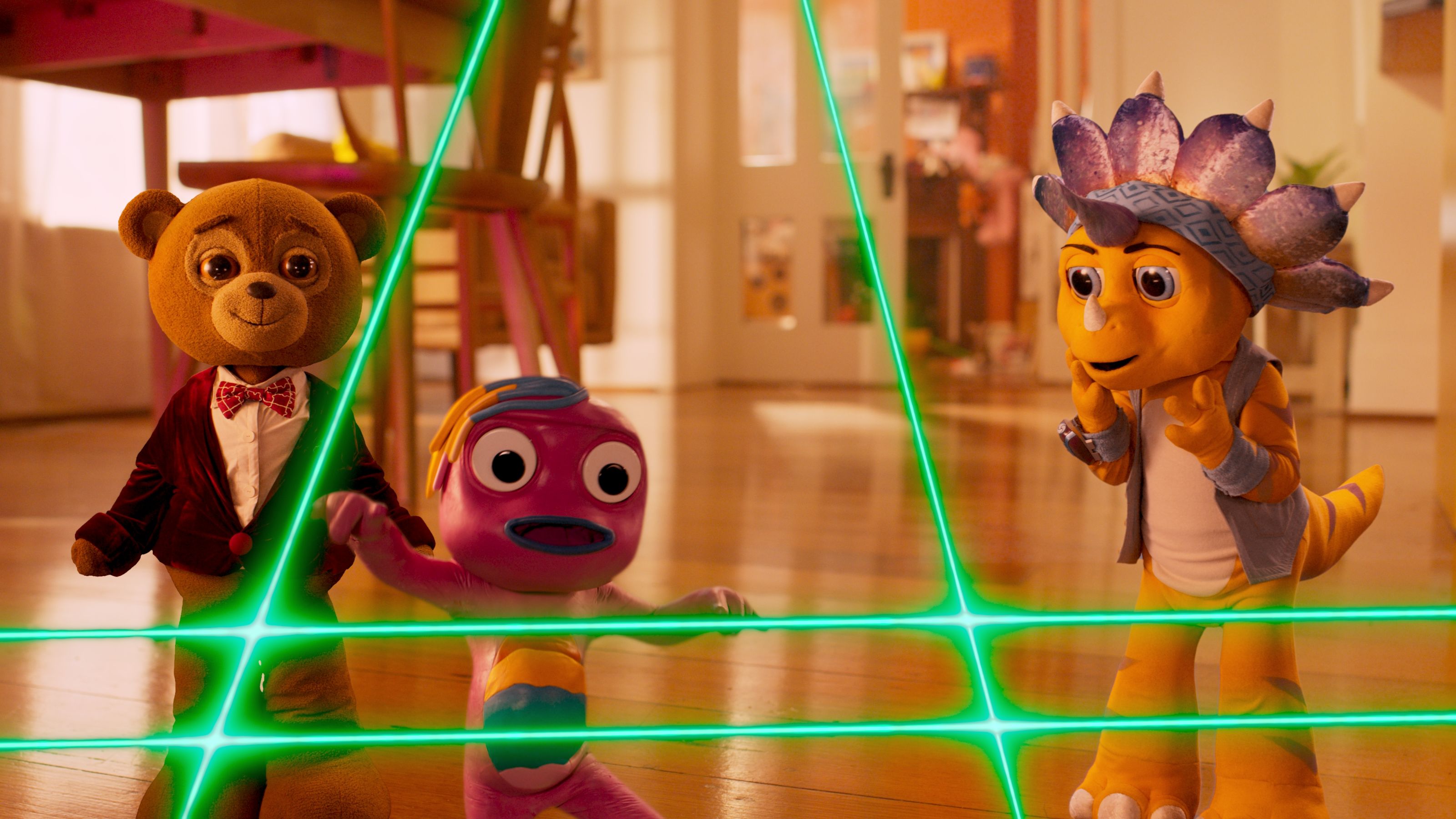
Mission 1: Maths Puzzles
Learning intention: We are learning to sort, recognise, name and describe familiar shapes.
I can:
- use mathematical language to describe shapes, such as round, edges, and sides.
- sort objects in my classroom into different types of shapes.
- name shapes correctly.
Watch
Watch the scene below from Episode 16: ‘'Mission Disco Party Pooper’' where Jeremy Buttons needs to crack the code and complete the puzzle so he is able to get to the other side of the dance floor. Can you help him choose which shape to stand on so he doesn’t get carried away by a giant bubble?
Reflect
After watching the scene from Knee High Spies, discuss the following questions as a class:
-
What did Jeremy Buttons need to do to solve the puzzle?
-
Why couldn’t he step on any shape?
-
How did Jeremy solve the problem when the star shape was too far away?
-
What other shapes do you know that were not included on the dance mat?
Encourage students to use mathematical language such as sides, corners, same length, long and short.
Explore
Write the following four shape clues on the whiteboard before the lesson:
- I am round and have no corners. You can roll me on the floor.
- I have 4 sides and all my sides are the same length.
- I have 3 sides and 3 corners. I look like a piece of pizza.
- I have 4 sides. 2 are long and 2 are short. I look like a door or a book.
Introduce the activity to the class:
“Calling all spies to mission control! Your teacher drew four shapes on the board. But oh no! Someone wiped them away and only left the clues. Can you read the clues and guess the shapes to help your teacher remember?”
Read each clue aloud and allow students to think or discuss with a partner before answering.
- I am round and have no corners. You can roll me on the floor. What shape am I? (Circle)
- I have 4 sides and all my sides are the same length. What shape am I? (Square)
- I have 3 sides and 3 corners. I look like a piece of pizza. What shape am I? (Triangle)
- I have 4 sides. 2 are long and 2 are short. I look like a door or a book. What shape am I? (Rectangle)
After each answer, draw the shape on the board and count the sides and corners together as a class.
Create
Step 1: Mission briefing
Gather students together and speak in a dramatic “mission control” voice:
“Spies, Jeremy Buttons needs your help again! The dance floor is full of tricky shapes. If we don’t choose carefully, WHOOSH - the bubble will carry us away! Your mission is to explore our classroom and find real-life shapes.”
Hold up the worksheet.
“You must find two objects for each shape: circle, square, triangle and rectangle. Spies, make sure you always look closely and count at the sides and corners!”
Before students begin, briefly model the thinking process. Pick up an object (for example, a book) and think aloud to the class:
I see 4 sides.
Are they all the same length? No… two are long and two are short.
It has 4 corners.
So this must be a… rectangle!
Ask the class:
- What made it a rectangle and not a square?
- What do I need to check before I decide?
Step 2: Investigation time
Students quietly explore the classroom. Explain expectations clearly:
- Walk, don’t run (quiet spies!)
- Touch and trace the edges if needed
- Double-check before drawing
Encourage mathematical language by prompting:
- How many sides does it have?
- Are the sides the same length?
- Does it have corners?
- Could it roll?
- Is it exactly a square, or just almost?
If a student chooses something incorrect, guide them by recounting the sides with them or prompting. Students can then draw the objects they find on their worksheet, if they are ready, they may try to label the objects as well.
Step 3: Mission debrief
Bring students back together and ask the class:
- Which shape was easiest to find? Why?
- Which shape was hardest?
- Did anyone find the same object for a different shape?
- Can shapes be different sizes but still be the same?
Finish with this mission reflection:
“Mission complete! You cracked it spies! Jeremy Buttons can cross the dance floor safely thanks to our expert Shape Detectives! Knee high spy five!”
Encourage students to ask their friends if they would like a high five.
Curriculum Links
|
|
Foundation |
Year 1 |
Year 2 |
|
Space |
Sort, name and create familiar shapes; recognise and describe familiar shapes within objects in the environment, giving reasons |
Compare and classify familiar shapes; recognise familiar shapes and objects in the environment, identifying the similarities and differences between them
|
Recognise, compare and classify shapes, referencing the number of sides and using spatial terms such as “opposite”, “parallel”, “curved” and “straight” |
|
|
Foundation |
Year 1 |
Year 2 |
|
Inquiring - Identify, process and evaluate information |
Identify and explore relevant points in information provided on a topic
|
Identify and explain similarities and differences in selected information |
|
|
Generating - Put ideas into action |
Put ideas into action through trial-and-error experiences
|
Put ideas into action by experimenting with options |
|
|
Analysing - Draw conclusions and provide reasons |
Draw conclusions and make choices when completing tasks and identify the reasons for choices made |
Draw conclusions and make choices when completing tasks and explain the reasons for choices made |
|
|
Reflecting - Transfer knowledge |
Connect ideas and information between familiar learning experiences
|
Use ideas and information from a previous experience to inform similar learning experiences
|
|
|
|
Foundation |
Year 1 |
Year 2 |
|
Measurement and Geometry - Understanding Geometric Properties |
Uses everyday language to describe and compare shapes and objects (e.g. round, small, flat, pointy)
Locates and describes similar shapes and objects in the environment (e.g. when playing a game of netball or football describes and locates the centre circle; uses a collection of objects with a similar shape or objects as subject matter for a visual artwork, and documents the similarities and differences between each object that has inspired their work)
Names familiar shapes in the environment (e.g. recognises circles, triangles, and rectangles in the design of the school) |
Identifies and describes features of shapes and objects (e.g. sides, corners, faces, edges and vertices)
Sorts and classifies familiar shapes and objects based on obvious features (e.g. triangles have 3 sides; a sphere is round like a ball) |
|