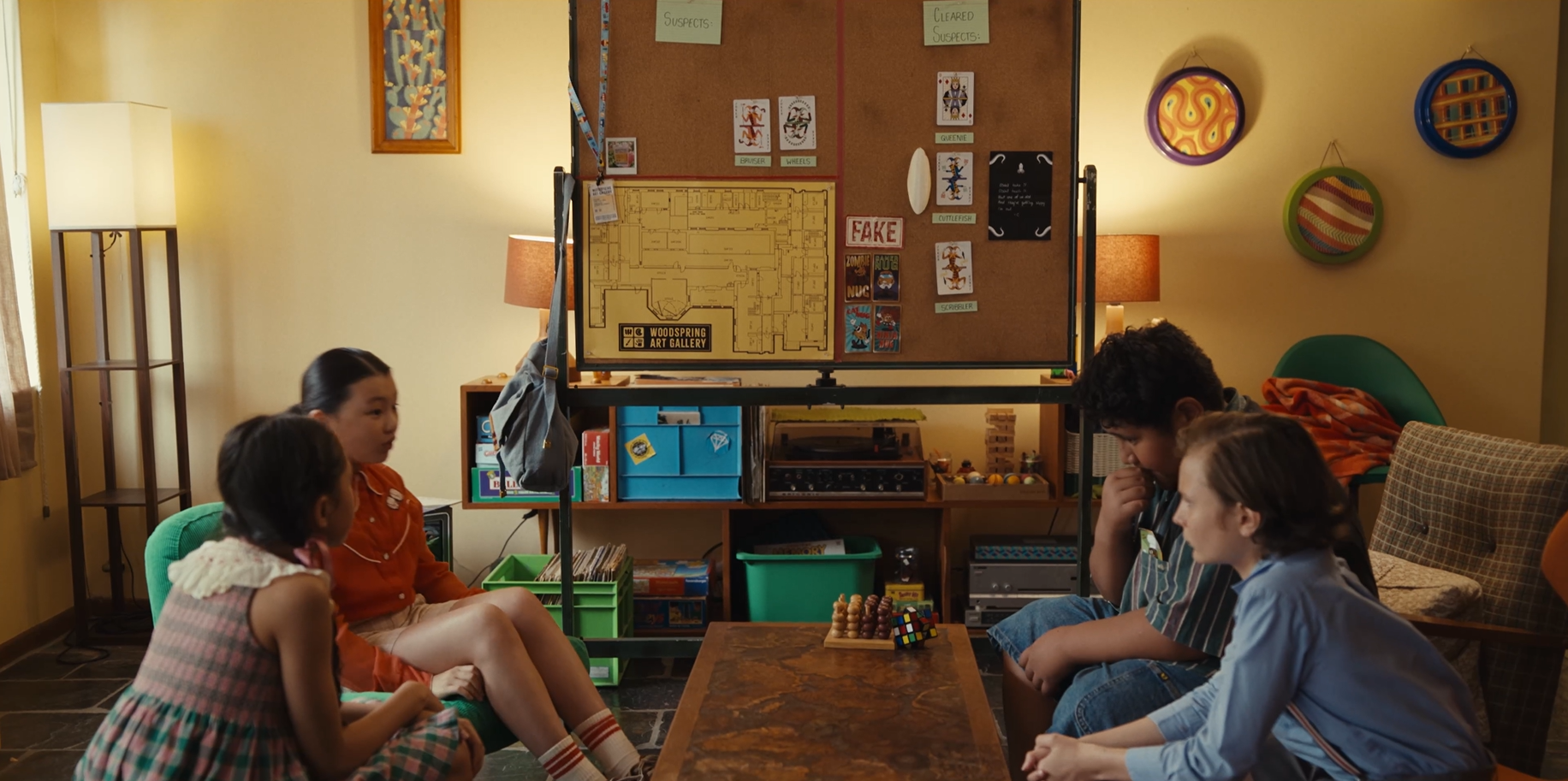
Mission 3: Who stole the woodspring nug (again!)?
By the end of ‘Mission 3’, students will be able to:
- use comprehension and inquiry skills to analyse and organise clues from different sources using a clue board
- draw logical conclusions
- collaboratively create and present a justified explanation using clear reasoning and evidence.
Mission Brief
The Joeys are going on a school excursion to the grand re-opening of the Planetarium. During the trip, something goes wrong - the Woodspring Nug has gone missing again. Your job is to work through the clues and figure out who took it.
In this activity, you will solve a “mini whodunnit”. That means you will investigate a mystery and try to work out who committed the crime. Just like in Caper Crew, you will need to look closely at the information, think carefully and work together.
To help you, you will create a clue board. A clue board is something detectives use to organise their ideas. You collect all your clues, evidence and suspects in one place and move them around as you learn more. It helps you see connections and solve the mystery step by step.
Like the Joeys, you will use your clue board to uncover what really happened to the missing Nug.
Activity 1
You will work in a small group or as a whole class to solve the mystery using a shared clue board.
You will need:
- Bluetack
- Markers or pencils
- Paper or a notebook for making notes.
Use the Mission 3 Case Dossier and the Mission 3 Brief to guide your thinking. These will give you the information, clues and instructions you need to investigate the case and work out what happened.
Click the square in the top right-hand corner of the Dossier and Brief to open the folder in full screen. Then use the arrow key to flip through the pages. You can also download each as a PDF.

For teachers only
Please download the Top Secret Teacher Guide for helpful prompts, the solution to the whodunnit and a ‘Mission debrief’ class reflection.
Click the square in the top right-hand corner of the Teacher Guide to open the folder in full screen. Then use the arrow key to flip through the pages. You can also download the document as a PDF.
Australian Curriculum
|
Year 3-4 |
Year 5-6 |
How this is demonstrated |
|
use comprehension strategies when listening and viewing to build literal and inferred meaning, and begin to evaluate texts by drawing on a growing knowledge of context, text structures and language features
plan, create, edit and publish written and multimodal imaginative, informative and persuasive texts, using visual features, relevant linked ideas, complex sentences, appropriate tense, synonyms and antonyms, correct spelling of multisyllabic words and simple punctuation
plan, create, rehearse and deliver short oral and/or multimodal presentations to inform, express opinions or tell stories, using a clear structure, details to elaborate ideas, topic-specific and precise vocabulary, visual features, and appropriate tone, pace, pitch and volume
|
use comprehension strategies such as visualising, predicting, connecting, summarising, monitoring and questioning to build literal and inferred meaning to evaluate information and ideas
plan, create, edit and publish written and multimodal texts whose purposes may be imaginative, informative and persuasive, using paragraphs, a variety of complex sentences, expanded verb groups, tense, topic-specific and vivid vocabulary, punctuation, spelling and visual features plan, create, rehearse and deliver spoken and multimodal presentations that include information, arguments and details that develop a theme or idea, organising ideas using precise topic-specific and technical vocabulary, pitch, tone, pace, volume, and visual and digital features
|
• Literacy/ comprehension & reasoning • creating and explaining ideas • English – analysing, interpreting, evaluating • creating logical explanations/ arguments
|
|
Year 3-4 |
Year 5-6 |
How this is demonstrated |
|
locate, collect and record information and data from a range of sources, including annotated timelines and maps
interpret information and data displayed in different formats
|
evaluate primary and secondary sources to determine origin, purpose and perspectives
evaluate information and data in a range of formats to identify and describe patterns and trends, or to infer relationships
|
Inquiry, evaluating sources, drawing conclusions
|
Considering fairness and bias
empathy, teamwork and discussion