Little Lunch: Personal & Social Capability
Activity 1: When things change
Learning intention: We are learning to understand how people respond differently to change, explore helpful coping strategies and identify ways to support ourselves and others.
Watch
Battie loves the old climbing tree as a place to sit and think, but Debra-Jo believes it is unsafe and should be removed. Watch how the children respond to the possibility of losing a familiar part of their playground.
Reflect
After watching the first clip, reflect as a class on these questions:
- What change is being proposed? Has it happened yet, or are the children responding to the possibility?
- How might Battie feel? What evidence from the clip supports your thinking?
- How did the other students respond?
- Why might a familiar place matter to someone’s sense of belonging?
- Can two people feel differently about the same change?
Explore
Change is a natural part of life. It can bring feelings of excitement, sadness, uncertainty or several feelings at once. Everyone needs different amounts of time and support to adjust to change.
With a partner, discuss how you can offer Battie understanding and advice on how to cope with losing the old climbing tree. Record some of your ideas including:
- Acknowledge the change: What will be different? What might stay the same?
- Name the feelings: How might he feel? What matters to him and what is he worried about?
- Find out more: Is there more information he can source? What questions could he ask? Who could help him and offer support?
- Plan helpful steps: What could he do to feel more settled and connected?
- Look for possibilities: What could he enjoy or look forward to? How could he make this new beginning special?
Watch the second clip and share your observations:
- How did Battie cope with the change when it happened?
- Do you think he prepared himself in advance? How might he have done that?
Create
Think of a change that is coming up in your life. It could be having a new teacher, being in a new classroom, going to high school, moving house, changing schools, returning after the summer holidays, starting at a new sport club, or something that is unique to you.
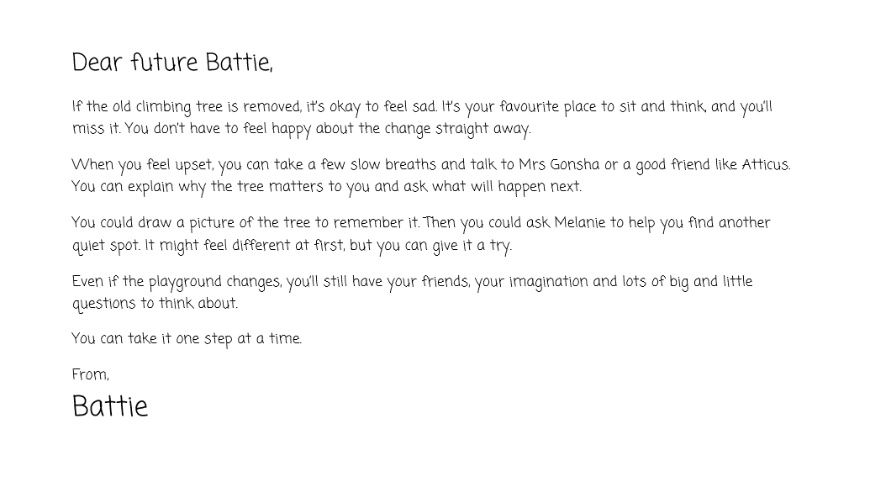
Write a letter to your future self to read when the change is happening. Offer yourself understanding, encouragement and practical ideas to help you adjust.
Don’t forget to:
- Acknowledge the change
- Name your feelings
- Find out more/Who can help?
- Plan helpful steps
- Look for possibilities
Finish with a kind, encouraging message to yourself. Remember, you can have mixed feelings about change and take time to adjust.
For example:
Activity 2: Showing that you care
Learning intention: We are learning to consider the perspectives and feelings of others and explore how understanding another person's experiences can influence the way they respond.
Watch
Melanie believes she has discovered a possum’s head in the sandpit and refuses to accept that it is just Rory’s craft project. When Debra-Jo remembers Melanie is grieving her pet rabbit, the children organise a small farewell so Melanie can say goodbye.
Reflect
After watching, reflect as a class on these questions:
- How do you think Melanie feeling when the others told her the possum was not real?
- Why do you think she found it difficult to accept what they were saying?
- What did Debra-Jo understand that the other children initially didn't?
- How did knowing about Melanie's rabbit change the way the children responded?
- Did the children need to believe it was really a possum to show Melanie empathy?
- Why might telling Melanie, "You're wrong. It's not real," not have helped her in that moment?
- What did Melanie need from her friends?
Explore
What is empathy?
Empathy is the ability to understand and share the feelings, thoughts, and experiences of another person. Empathy doesn’t mean you have to agree. You can understand and care about someone's feelings without agreeing with what they think or say. Empathy does not mean you need to fix somebody’s problem. It can be simply noticing, listening and showing that you care.
For example:
Agreement: "Yes, that's definitely a possum."
No empathy: "That's ridiculous. It's obviously not a possum."
Empathy: "I can see this is really upsetting you."
Let’s explore the 3-step empathy strategy
LOOK → THINK → RESPOND
1. LOOK
Notice clues. What is the person:
-
saying?
-
doing?
-
showing through their face or body language?
2. THINK
Consider what might be happening for them.
-
What might they be feeling?
-
Why might they feel that way?
-
Is there something happening that I don't know about?
3. RESPOND
Choose words or actions that show care.
What could I say or do that would help this person feel understood or supported?
Choose one of the scenarios below with a partner.
- Your friend becomes very upset because they cannot find their hat. You think getting upset over a hat seems silly.
- Someone becomes angry after losing a game that you thought was just for fun.
- A classmate doesn't want to join an activity because they are worried they won't be good at it.
- Your friend is unusually quiet at lunchtime and says they don't want to talk.
- A classmate cries when something they made gets accidentally broken.
For each scenario, students identify:
LOOK: What could you notice?
THINK: What might the person be feeling or experiencing?
RESPOND: What could you say or do?
Share responses to your class, you may choose to act out your scenario to your class demonstrating empathy.
Create
Think of your own scenario where showing empathy could help. You can use your imagination or use an experience from your own life.
Identify how the LOOK → THINK → RESPOND strategy would apply to your scenario.
Create a short comic strip detailing the scenario and how empathy could be used to support others.
Activity 3: Being Brave
Learning intention: We are learning to recognise what makes a situation feel challenging and explore how preparation, support and small steps can help us feel more confident to participate.
Watch
On a hot day, Atticus starts a joke competition. Melanie is terrified of speaking in front of everyone. Watch for clues about her feelings and what helps her move towards participating.
Reflect
After watching the clip, reflect on some of these questions:
- What clues in Melanie’s words, actions or body language suggest she is feeling nervous?
- Why might she want to participate and also want to avoid it?
- What might the be worried will happen?
- What helps her take a step towards participating?
- How could her friends offer support while allowing Melanie to decide what she is ready to try?
- If Melanie told her joke and nobody laughed, what could she still feel proud of?
- What situations at school might bring up similar feelings?
- Could someone look confident on the outside and feel nervous inside?
- Could the same activity feel easy for one person and challenging for another?
- How might asking for help be a brave step?
Explore
Feeling nervous is a common response to something unfamiliar or challenging. You might notice butterflies in your stomach, a faster heartbeat, a shaky voice or thoughts such as, “What if I get it wrong?”
These feelings can make it difficult to do something you want to do.
Being brave does not mean you have to feel completely confident. It can mean taking a manageable step towards something that matters to you, with preparation and support.
Build a bravery ladder
A bravery ladder breaks a goal into smaller actions. Rather than trying to do everything at once, you begin with a step that feels manageable and build from there.
Imagine Melanie has asked you to help her prepare for the joke competition. Together, label these suggested actions from 1-5, from a manageable first step to her final goal:
Tell a joke to a small group of friends.
Choose a joke she likes.
Tell the joke at the competition.
Practise saying the joke aloud on her own.
Tell the joke to one trusted friend.
For each step, consider:
- How could Melanie prepare?
- What support could she ask for?
- How would she know she had made progress?
Create
Choose something at school you would like to try or feel more confident doing. You may choose a real goal or invent a goal for one of the Little Lunch characters.
Create a bravery ladder with five rungs. Use words, drawings or a combination of both.
Include:
- Your goal: What would I like to be able to do?
- 5 steps: What small actions could help me work towards my goal?
- Your support: Who could help, and what could I ask them to do?
Decorate your ladder and encourage yourself with some positive quotes to keep trying - “I can do this!”
Australian Curriculum Links
Personal and Social Capability 5/6
Self-management -
Emotional Regulation: manage personal factors influencing emotions in a range of contexts including learning
Perseverance and adaptability: adapt approaches to tasks to support perseverance when faced with challenging or unfamiliar tasks
Personal and Social Capability 3/4
Self-management-
Emotional Regulation: manage and moderate emotions in familiar contexts, using provided strategies
Perseverance and adaptability: demonstrate perseverance when faced with challenges, adapting approaches based on successes and learning from setbacks and failure
Health and Physical Education 5/6
AC9HP6P02 - investigate resources and strategies to manage changes and transitions, including changes associated with puberty.
Health and Physical Education 3/4
AC9HP4P02 - plan, rehearse and reflect on strategies to cope with the different changes and transitions they experience, such as the changes associated with puberty
Year 3/4 Australian Curriculum Links:
Personal and Social Capability: Social Awareness: Empathy
Health and Physical Education
AC9HP4P04 - select, use and refine personal and social skills to establish, manage and strengthen relationships
Personal and Social Capability 5/6
Self-management -
Emotional Regulation: manage personal factors influencing emotions in a range of contexts including learning
Perseverance and adaptability: adapt approaches to tasks to support perseverance when faced with challenging or unfamiliar tasks
Personal and Social Capability 3/4
Self-management-
Emotional Regulation: manage and moderate emotions in familiar contexts, using provided strategies
Perseverance and adaptability: demonstrate perseverance when faced with challenges, adapting approaches based on successes and learning from setbacks and failure
Health and Physical Education 5/6
AC9HP6P06 - apply strategies to manage emotions and analyse how emotional responses influence interactions
Health and Physical Education 3/4
AC9HP4P01 - investigate how success, challenge, setbacks and failure strengthen resilience and identities in a range of contexts explain how and why emotional responses can vary and practise strategies to manage their emotions
AC9HP4P06 - explain how and why emotional responses can vary and practise strategies to manage their emotions