
Little Lunch: English
Activity 1: What They Said vs What They Meant
Learning intention: We are deepening our understanding of figurative language by learning to identify, describe and create idioms. We are learning to explain the purpose of including idioms in texts and their effects on the intended audience.
Watch
In Little Lunch, Episode 1: 'Principal’s Office' Rory is punished for biting Melanie on the hand and he is sent to the principal’s office. The other kids feel unexpectedly sorry for him and try to cheer him up by passing him notes through the window.
Reflect
Mrs Gonsha is always saying "Oh Rory, have you got ants in your pants?".
Mrs Gonsha told Rory to have a "long good hard think about what he did".
Atticus hoped that Rory was okay in "the big house".
Melanie wrote "see you later alligator" in her note to Rory.
What do you notice about the language used in these clips?
These phrases are examples of a figurative language feature called ‘idioms’. An idiom is a phrase or expression whose meaning cannot be understood from the literal definition of its individual words. Idioms have three key features:
- They are non-literal.
- They are often unique to a language, culture or region, making them difficult for non-native speakers to understand.
- They have a fixed structure and the word order cannot be changed.
As a class, discuss the figurative meaning of the four idioms above from Episode 1: 'Principal’s Office'. Explain the purpose of including idioms in this episode and the intended audience. Discuss other examples of when you could use these idioms.
Explore
In pairs, create a table and brainstorm other idioms that you know and record their figurative meaning. Include when a person might use them and give an example.
| Idiom | Figurative meaning | Said when | Example |
| She'll be right | Everything will be okay | ...something has gone wrong but it isn't a big problem. | My sandwich got a bit squashed in my lunchbox and my teacher said "She’ll be right! It will still taste the same." |
Some common idioms you might like to include are:
- piece of cake
- break a leg
- hold your horses
- under the weather
- spill the beans
- hit the nail on the head
What others can you think of?
Create
Individually, create your own original idiom and explain the literal meaning, the figurative meaning, when someone might say it, and give an example.
Here's an example that might help your creative thinking: "My brain is stuck in pyjamas."
| Literal meaning | Figurative meaning | Said when | Example |
| My brain is wearing pyjamas. | I’m tired and I can’t think properly. | A person makes a silly mistake. | She was up late last night studying, so today her brain is stuck in pyjamas. |
Idioms can only really become idioms if lots of people begin using and understanding them in the same non-literal way over time. So share yours with your friends and family and see if your idiom catches on!
Activity 2: Character Clues
Learning intention: Explore how a character’s actions, words and relationships with others help an audience understand their personality, feelings and motivations. Use evidence from Little Lunch, Episode 2: 'Dress Up Day' to explain your ideas about Battie’s character.
Watch
On Dress-Up-As-What-You-Want-To-Be-When-You-Grow-Up Day, Battie dresses up as Stretcho, his very own made-up superhero. Battie and his friends compare how his personality changes when he is dressed as Stretcho with how he usually behaves on a regular day.
Watch Little Lunch, Episode 2: 'Dress Up Day' on ABC iView or download to own from the ACTF Shop.
As you watch, look for clues that show how Battie behaves differently when he is himself and when he is dressed as Stretcho.
Reflect
After watching, reflect as a class on these questions:
- What do we learn about Battie in this episode?
- What are three words you could use to describe Battie when he is dressed as Stretcho?
- What are three words you could use to describe Battie on a regular day?
- What do the other children seem to understand about Battie? Do all of the characters see Battie in the same way?
- What do Battie or his friends say that supports your ideas?
- What do Battie or his friends do that supports your ideas?
Explore
Writers and filmmakers give us character clues to help us understand their characters. These clues can come from:
- What a character says
- What a character does
- What other characters say about them
- How other characters respond to them
Work in pairs to become Character Investigators as you rewatch Episode 2: 'The Dress-Up Day'. One partner will investigate Battie when he is dressed as Stretcho, and the other partner will investigate Battie on a regular day as himself. Your job as investigators is to look for the clues in the episode to describe Battie’s character traits. Decide whether Battie shows more introverted or more extroverted traits in each situation.
What are introverted personality traits? Quiet, reserved, thoughtful, reflective, observant, calm, independent, cautious, a good listener, prefers small groups, enjoys time alone.
What are extroverted personality traits? Outgoing, sociable, talkative, energetic, confident, friendly, enthusiastic, lively, enjoys being around others and meeting new people.
You can use the Character Investigation Activity Template to record your evidence.
Share and compare your evidence with your partner’s evidence.
TEMPLATE - WILL REPLACE WITH DESIGNED ASSET
Create
Using your Character Investigation and your partner’s findings, write a paragraph summarising Battie’s character in Little Lunch: Episode 2: 'The Dress-Up Day'. In your paragraph:
- describe Battie’s usual personality
- explain how his behaviour changes when he becomes Stretcho
- use at least 2 examples of evidence from the episode
- explain what these examples reveal about Battie
You may like to respond to this question: Do you think Battie really becomes a different person when he is Stretcho, or does Stretcho allow him to show another side of his personality? Explain your thinking.
Activity 3: Vote for Me!
Learning intention: Explore how speakers use persuasive language and techniques to influence an audience. Analyse the effectiveness of different persuasive choices in Little Lunch, Episode 23: 'The Election' and apply these techniques to create your own persuasive campaign speech.
Watch
Rory announces that he wants to be prime minister, prompting a class election. Debra-Jo and Tamara join the race and the three candidates begin campaigning for votes by delivering persuasive speeches to their classmates.
Watch Little Lunch, Episode 23: 'The Election' on ABC iView or download to own from the ACTF Shop.
Then rewatch the below clip, focus on how each candidate tries to convince the other students to vote for them. Look and listen for:
- What the candidates promise
- Whether they appeal to their audience’s wants or feelings
- Whether they appeal to the wider community’s needs
- How the audience responds
Reflect
After watching, reflect as a class on questions such as:
- Who is the audience for the speeches?
- What promises does each candidate make?
- Which campaign messages seem to get the strongest reaction from the other students?
- What words or phrases make a candidate sound convincing?
- Does each candidate give reasons to support their promises, or do they simply make claims?
- What was missing from Rory’s first speech? Was it effective?
- How do the candidates adapt what they say to appeal to their particular audience?
Introduce the idea that persuasion is about more than having a good idea. Speakers make deliberate language choices to influence what an audience thinks, feels or does.
Explore
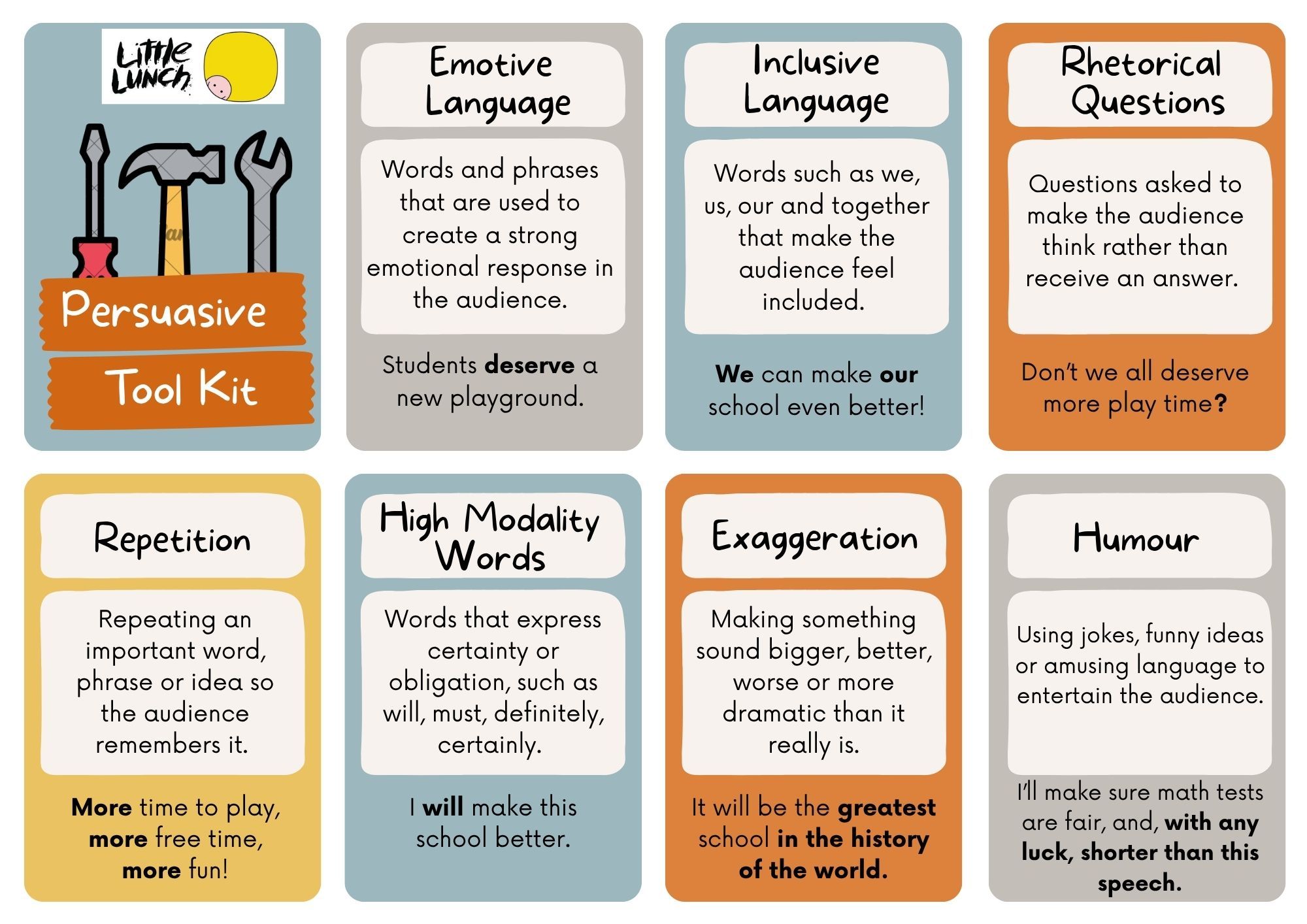
Use your Little Lunch Persuasion Toolkit to identify the persuasive language and techniques used by of Debra-Jo, Tamara and Rory in their campaign speeches.
- Emotive language: words and phrases that are used to create a strong emotional response in the audience. E.g. Students deserve a new playground.
- Inclusive language: words such as we, us, our and together that make the audience feel included. E.g. We can make our school even better!
- Rhetorical questions: questions asked to make the audience think rather than receive an answer. E.g. Don’t we all deserve more play time?
- Repetition: repeating an important word, phrase or idea so the audience remembers it. E.g. more time to play, more free time, more fun!
- High modality words: words that express certainty or obligation, such as will, must, definitely, certainly. E.g. I will make this school better.
- Exaggeration (hyperbole): making something sound bigger, better, worse or more dramatic than it really is. E.g. It will be the greatest school in the history of the world!
- Humour: using jokes, funny ideas or amusing language to entertain the audience and make a message more engaging or persuasive. E.g. I’ll make sure maths tests are fair, and, with any luck, shorter than this speech.
TEMPLATE - WILL REPLACE WITH DESIGNED ASSET
Create
Pretend you are campaigning to be your ‘Class Prime Minister’. You are going to write and deliver a campaign speech to your classmates.
Step 1: Plan your campaign
Before writing, create a brainstorm about your audience:
- What matters to students your age?
- What problems might they like solved?
- What ideas would appeal to them?
- Which promises could you realistically make?
Choose three campaign ideas. For each idea, you need a promise, a reason, and a supporting detail.
For example:
- Promise: I will make a class games box for wet-day little lunches.
- Reason: We should still be able to have fun when we can’t play outside.
- Supporting detail: The box will include cards, puzzles, and board games chosen by the class.
Use your Little Lunch Persuasion Toolkit to help you develop your ideas.
Step 2: Write your campaign speech
Begin with a strong opening that captures your audience’s attention. Introduce yourself and your main campaign message.
Present your three campaign ideas. Use your Little Lunch Persuasion Toolkit to assist you in including at least four to five persuasive techniques in your speech.
Conclude your speech with a memorable slogan or call to action that encourages your classmates to vote for you.
Step 3: Deliver your campaign
Think about how your voice and body language can support your words:
- volume
- pace
- expression
- pauses
- emphasis
- eye contact
- gestures
Rehearse and present your campaign speech to a partner, small group, or the class.
Ask for feedback from your audience to identify one persuasive technique they noticed and which promise they were most influenced by.
Australian Curriculum Links
Year 3
AC9E3LA03 Describe how texts across the curriculum use different language features and structures relevant to their purpose
AC9E3LY03 Identify the audience and purpose of imaginative, informative and persuasive texts through their use of language features and/or images
Year 4
AC9E4LA03 Identify how texts across the curriculum have different language features and are typically organised into characteristic stages depending on purposes
Year 3
AC9E3LE03 Discuss how an author uses language and illustrations to portray characters and settings in texts, and explore how the settings and events influence the mood of the narrative
AC9E3LY05 Use comprehension strategies when listening and viewing to build literal and inferred meaning, and begin to evaluate texts by drawing on a growing knowledge of context, text structures and language features
Year 4
AC9E4LE03 Discuss how authors and illustrators make stories engaging by the way they develop character, setting and plot tensions
AC9E4LY05 Use comprehension strategies such as visualising, predicting, connecting, summarising, monitoring and questioning to build literal and inferred meaning, to expand topic knowledge and ideas, and evaluate texts
Year 5
AC9E5LA03 Describe how spoken, written and multimodal texts use language features and are typically organised into characteristic stages and phases, depending on purposes in texts
AC9E5LY06 Plan, create, edit and publish written and multimodal texts whose purposes may be imaginative, informative and persuasive, developing ideas using visual features, text structure appropriate to the topic and purpose, text connectives, expanded noun groups, specialist and technical vocabulary, and punctuation including dialogue punctuation
Year 6
AC9E6LY03 Analyse how text structures and language features work together to meet the purpose of a text, and engage and influence audiences
AC9E6LY06 Plan, create, edit and publish written and multimodal texts whose purposes may be imaginative, informative and persuasive, using paragraphs, a variety of complex sentences, expanded verb groups, tense, topic-specific and vivid vocabulary, punctuation, spelling and visual features